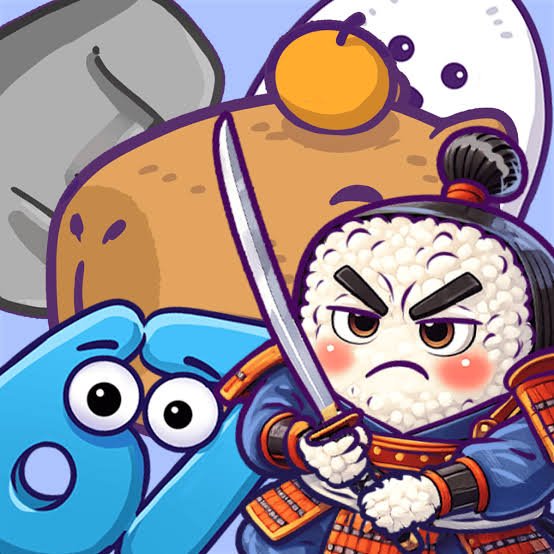
Merge Rot is a physics-based merge puzzle where you drop strange characters and objects into a container, then combine matching pieces into larger and increasingly unusual versions. The basic idea resembles watermelon-style merge games, but the themes lean heavily into internet meme culture, with options based around Brainrot characters, Giga themes, dogs, cats, capybaras, and other visual sets.
The first mistake I made was dropping pieces directly onto their matching partner every time. That works when the container is mostly empty, but once the pile grows, the collision can push both pieces into an awkward position. I had better results when I started thinking about where the merged piece would settle after the contact rather than only whether the first collision would happen.
| Game Detail | Information |
|---|---|
| Game | Merge Rot |
| Original Name | Merge Fellas |
| Developer | TapMen |
| Genre | Brain / Merge / Physics Puzzle |
| Gameplay Style | Drop-and-merge container puzzle |
| Controls | Move with mouse, click to drop |
| Mobile Controls | Touch / tap |
| Supported Devices | Desktop, Phone and Tablet |
| Browser Release | May 2025 |
| Latest Verified Browser Update | July 2026 |
| Current Browser Rating | 4.5 |
| Current Browser Votes | 562K+ |
| Multiplayer | Single-player |
The current browser edition identifies TapMen as the developer and confirms May 2025 as the release period, July 2026 as the latest update, and desktop, phone, and tablet support.
Merge Rot Started As Merge Fellas
One detail worth knowing is that Merge Rot was originally known as Merge Fellas.
The current browser listing says the game was first released under that earlier name before becoming widely known as Merge Rot. The name changed, but the core gameplay did not.
That explains why older screenshots or search results may sometimes use a different title even though they refer to essentially the same game.
I would not treat Merge Fellas and Merge Rot as two unrelated games unless a particular site clearly identifies a separate version.
Drop Matching Pieces Into The Cup
Every turn begins with an item above the container.
Move it horizontally, decide where it should fall, then release it.
When two identical items collide, they merge into the next larger version.
The basic progression is:
drop → collide → merge → create a larger character → repeat
The challenge gradually shifts from creating individual matches to managing the limited space inside the container.
Merge Rot Controls
The controls are deliberately minimal.
- Mouse movement: Position the current item
- Left click: Drop the item
- Touchscreen: Position and release through touch input
The current browser listing confirms mouse movement and click-to-drop controls.
For technical context, the MDN Pointer Events documentation explains how modern web applications can handle mouse, touch, and pen input using a shared interaction system.
Matching Characters Grow Into Stranger Ones
Every successful merge creates a higher-level piece.
That is where most of the visual variety appears.
Rather than using only fruit or numbered circles, Merge Rot uses exaggerated characters and meme-inspired objects that become stranger as the sequence progresses.
The current game description specifically mentions themes including:
- Italian Brainrot
- Giga
- Dogs
- Cats
- Fellas
- Capybaras
These themes mostly change the visual identity of the pieces while keeping the merge loop familiar.
Multiple Themes Change The Look
One of Merge Rot’s more distinctive features is the ability to choose among different theme sets.
A dog-themed run and a Brainrot-themed run may look completely different even though the underlying merge mechanics are similar.
I like this because physics merge games can become visually repetitive after several attempts.
Changing the theme gives you a fresh sequence of characters without making you learn a new control system.
Physics Makes Every Drop Slightly Uncertain
Merge Rot is not a fixed grid puzzle.
Pieces can bounce, roll, shift, and push neighboring objects after they land.
That makes placement less predictable than it appears from the top of the container.
A drop that looks perfectly centered can still move sideways after hitting another piece.
This is why I stopped aiming only at the exact center of matching characters.
Sometimes dropping slightly beside the target and letting the new piece roll into contact gives a cleaner result.
Keep Large Pieces Near The Bottom
The largest merged characters occupy much more space.
If they remain high in the pile, they can reduce the amount of safe room available for future drops.
I try to keep the biggest pieces toward the bottom whenever the physics allows it.
That creates two advantages.
First, the top of the container remains open.
Second, smaller pieces have more room to move toward matching partners.
This becomes much more important once several high-level characters are already on screen.
Empty Space Matters As Much As Score
A successful merge is not automatically a good move.
If it creates a large piece in the center of the container and leaves several small gaps around it, the board can become harder to manage.
I started treating empty space as another resource.
A useful move should ideally:
- create a higher-level character
- lower the overall pile
- leave flexible landing areas
That is often more valuable than chasing one immediate high-scoring merge.
Chain Merges Are The Best Moments
Sometimes one merge creates a new character directly beside another matching one.
That can trigger a second merge almost immediately.
Several merges can sometimes happen in sequence.
The current browser description specifically encourages positioning pieces so that multiple merges can be triggered together.
I found these chains much easier to create when related sizes were kept in the same general area instead of scattered across the container.
Do Not Separate Your Largest Matches
Two valuable matching characters can become almost useless if they sit on opposite sides of the cup with several other pieces between them.
That happened to me repeatedly in early runs.
Now I try to build similar high-level pieces reasonably close together.
They do not need to touch immediately.
They just need a realistic path toward one another later.
This makes the late game much easier to manage.
When Does Merge Rot End?
The run effectively ends when the container becomes too full to accept more pieces.
The current game description warns players to keep merging before the board or container fills.
That gives every drop a tradeoff.
A merge can improve your score, but a badly positioned piece can raise the pile enough to threaten the entire run.
This is why surviving longer usually requires more planning than simply creating the biggest character as quickly as possible.
A Better Drop Routine
Before dropping a piece, I usually check three things:
- Where is the nearest identical character?
- If they merge, where will the new piece probably settle?
- Will that position leave useful room for the following drop?
That small routine reduces a surprising number of bad placements.
You cannot control every bounce, but you can make the physics work in a more useful area.
Theme Choice Does Not Replace Strategy
It is easy to focus on the novelty of the different character sets.
The actual puzzle remains about space.
Whether you are using dogs, cats, capybaras, Giga characters, or Brainrot-themed pieces, the same principles keep appearing:
- avoid unnecessary height
- keep matching sizes reasonably close
- leave open landing zones
- plan around the next merge
The visual theme changes the presentation more than the core decision-making.
Who Created Merge Rot?
Merge Rot was created by TapMen.
The current browser listing identifies it as TapMen’s first game on that particular platform.
That developer attribution is worth using rather than copying from unofficial game mirrors, because several third-party pages incorrectly attach different developer names to the same title.
For Mopoga, TapMen is the developer I would use.
Release And Latest Update
The current verified browser release is May 2025.
The latest verified update is July 2026.
Some older localized listings still show April 2026 as the latest update because they were crawled before the July refresh. The English listing is newer and currently shows July 2026.
That is why I would use July 2026 for Mopoga rather than the older April date.
Desktop, Phone And Tablet Support
Merge Rot currently supports:
- Desktop
- Phone
- Tablet
The control system adapts well because the game only needs horizontal positioning and a drop action.
I prefer desktop when the container becomes crowded because the mouse gives very deliberate placement.
Touchscreens feel natural for shorter sessions because dragging and tapping already match the game’s simple interaction.
The W3C Pointer Events specification provides technical background on how browsers can support different pointing devices through a common standard.
Browser Performance
Merge Rot relies on physics calculations and animated collisions, so smooth browser performance can affect how easy the movement is to read.
Google’s web.dev performance guidance explains how rendering and responsiveness affect interactive web content.
If drops suddenly look choppy, I would first close unusually heavy tabs and reload the page.
That makes it easier to separate an actual physics outcome from a visual slowdown.
Merge Rot Compared With Blob Drop
Merge Rot and Blob Drop share a similar basic structure.
Both involve:
- dropping pieces into a container
- physics-based movement
- matching pairs
- larger merged pieces
- limited space
- overflow pressure
The biggest difference is presentation.
Blob Drop uses colorful blob characters, while Merge Rot leans much more heavily into internet meme themes and rapidly changing character designs.
Players who care mainly about the puzzle mechanics may enjoy both.
Players who specifically like meme-based visual themes will probably find Merge Rot more distinctive.
Merge Rot Compared With Impossible 13
Impossible 13 also revolves around combining matching values, but it behaves very differently.
Impossible 13 uses a more structured number board.
Merge Rot uses gravity and collision physics.
That difference changes the planning.
Impossible 13 is more predictable because pieces remain within a clearer arrangement.
Merge Rot can surprise you because one collision may move several nearby characters.
Common Mistakes I Made
My first mistake was dropping directly on top of every matching piece.
The second was allowing large characters to remain near the top.
The third was spreading similar high-level pieces across opposite sides of the container.
All three problems became worse later in the run.
Once I started planning around the resulting position rather than only the immediate merge, the board stayed usable for much longer.
What Makes Merge Rot Different?
Merge Rot combines familiar physics merging with a much more internet-focused visual style.
Its main features include:
- drop-and-merge gameplay
- physics-based collisions
- Brainrot themes
- Giga themes
- dogs
- cats
- Fellas
- capybaras
- chain merges
- limited container space
- desktop and mobile support
- high-score progression
The rules are very easy to understand.
The real challenge appears after the cup fills with several different character sizes and every new drop affects the pieces already there.
Related Games On Mopoga
Merge Rot fits naturally beside Mopoga games built around merging and space management.
Blob Drop is the closest comparison because both use falling physics and matching pieces.
Impossible 13 offers a more structured number-merging puzzle, while Gem 11 is another useful choice for players who prefer numerical progression.
I have not invented Mopoga product URLs where the exact sitemap URL could not be verified.
The authoritative internal-link feeds remain:
https://imopoga.com/product-sitemap.xml
https://imopoga.com/product_cat-sitemap.xml
Once their exact product URLs are readable, the best internal-link pattern would be to connect Merge Rot contextually with Blob Drop, Impossible 13, and another verified merge/puzzle page rather than forcing unrelated links.
About Merge Rot
Merge Rot is easy to understand because every run starts with the same simple action: position a piece and drop it.
What makes the game harder is everything that happens afterward.
Pieces bounce, larger characters consume more space, and poorly placed matches can leave the container difficult to recover.
For me, the biggest improvement came from thinking one merge ahead.
Instead of asking only whether two pieces can connect, I started asking where the new, larger piece would end up.

Reviews
There are no reviews yet.