

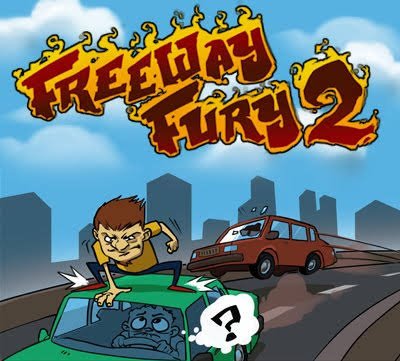
Freeway Fury 2 is a top-down arcade driving game created by Vasco Freitas of Serius Games. It takes the unusual idea from the original Freeway Fury and expands it into a larger game with timed freeway stages, vehicle switching, score-based bonuses, seven possible finish-line routes, a final boss sequence, and a separate Free Ride mode.
The game is deliberately exaggerated and should be treated purely as fictional arcade gameplay. Its vehicle-jumping and traffic mechanics are not examples of safe real-world driving.
| Game Detail | Information |
|---|---|
| Game | Freeway Fury 2 |
| Developer | Vasco Freitas, Serius Games |
| Genre | Arcade, Driving |
| Perspective | Top-down |
| Gameplay Style | Timed freeway stages, vehicle switching, score chasing |
| Steering | Left and Right Arrow Keys |
| Vehicle Change | Z or M with directional input |
| Nitro | Up Arrow, X, or N |
| Supported Device | Desktop |
| Original Release | November 17, 2011 |
| Latest Verified Original Update | December 4, 2011 |
| Original Technology | Flash |
| Finish-Line Routes | 7 |
| Extra Mode | Free Ride |
| Multiplayer | Single-player |
Kongregate records November 17, 2011 as the original release and December 4, 2011 as its latest listed update. Newgrounds independently shows the same November 17 upload date, while Armor Games added its hosted edition on November 29.
How Freeway Fury 2 Works
Each freeway section gives you a limited amount of time to reach the finish.
Instead of staying with one vehicle from beginning to end, the game’s central mechanic lets your character move between vehicles during the run. Different vehicles and traffic situations change how easily you can continue through a stage.
The sequel also rewards successful in-game stunt sequences with score and nitro, although these mechanics are deliberately unrealistic arcade systems rather than driving simulation.
The basic progression becomes:
move through the freeway → change vehicles when needed → reach the finish before time expires → choose another route → work toward all seven endings.
Freeway Fury 2 Controls
The original desktop controls use the keyboard.
Left and Right Arrow Keys steer the current vehicle. Z or M prepares the game’s vehicle-change action, combined with a directional key. Up Arrow, X, or N activates the in-game nitro system. Serius Games also documents Space as an alternate key for the vehicle-change mechanic.
Because this is a fictional arcade game built around intentionally impossible freeway action, these controls should stay firmly inside the game.
The Timer Shapes Every Stage
Freeway Fury 2 is not an open-ended driving game in its main mode.
Each freeway section has a time limit.
That immediately changes how you think about progress.
You are not simply trying to keep one vehicle intact for as long as possible. You need to keep moving toward the next finish point before time runs out.
I found that the timer makes route awareness more useful than simply watching the score.
If you lose track of where the stage is taking you, even a high-scoring run can end before reaching the next finish.
Vehicle Switching Is The Main Mechanic
The defining idea of Freeway Fury 2 is changing vehicles during a run.
The first game already used this unusual mechanic, but the sequel builds more progression around it.
Instead of treating your starting vehicle as permanent, the game expects you to adapt as the freeway changes.
That gives the game a very different rhythm from traditional racing titles.
The vehicle is temporary.
Forward progress is what matters.
Do Not Treat It Like A Normal Racing Game
Freeway Fury 2 may contain cars, motorcycles, and roads, but its design is closer to an arcade action game than realistic racing.
You are working against a timer.
Vehicles are disposable.
Score systems reward exaggerated fictional actions.
Routes can lead to different endings.
The game is therefore easier to understand when you stop expecting realistic driving physics and treat each freeway as an arcade stage.
Seven Different Finish Lines
One of the biggest additions in Freeway Fury 2 is its branching progression.
The developer confirms that there are seven different finish lines to reach. Completing them leads toward the final boss battle.
This gives repeated runs a purpose.
Reaching one finish does not mean you have seen everything.
You can return and follow a different route to work toward another ending.
That structure makes the sequel considerably broader than simply trying to improve one endless score.
Route Choice Matters
Because there are seven possible finishes, the freeway is not just one straight path through the whole game.
Different route decisions can lead toward different outcomes.
I would concentrate on remembering which route you used during a successful run.
That makes it easier to intentionally choose something different later rather than accidentally repeating the same ending.
The useful question becomes:
Which finish have I not reached yet?
That gives later runs a clearer goal.
The Final Boss Requires All Seven Routes
Serius Games specifically states that reaching all seven finish lines unlocks the final boss battle.
That makes the endings part of actual progression rather than simple alternate closing screens.
A player who reaches one ending has completed a run.
A player who wants to see the full progression needs to return and complete the remaining routes.
This was an ambitious structure for a browser arcade game released in 2011.
Free Ride Mode Changes The Pace
Freeway Fury 2 also includes Free Ride mode.
Armor Games and Newgrounds both describe it as a separate mode with modifications to the standard game.
The main campaign puts pressure on you with timed stretches and route progression.
Free Ride removes some of that emphasis and gives the game’s arcade systems more room to stand on their own.
That makes it useful when you want the basic mechanics without concentrating on collecting all seven endings.
Nitro Is An Arcade Resource
Nitro provides a temporary in-game speed increase.
The developer offers several equivalent keys for activating it:
Up Arrow, X, or N.
I would think of nitro as part of the game’s score-and-timing system rather than realistic vehicle behaviour.
The important point is that the game sometimes gives you another way to gain forward progress when a stage becomes tight on time.
Scores Give Repeat Runs Another Goal
Freeway Fury 2 includes score-based systems alongside its route progression.
Kongregate’s original version also received additional high-score statistics around launch.
That creates two different reasons to replay.
One is completion.
Reach all seven endings.
The other is performance.
Improve the result of a route you already understand.
I would concentrate on completion first.
Once the freeway layouts become familiar, score chasing becomes easier because you know what comes next.
Learn The Route Before Chasing A Score
Trying to maximize score immediately can make an unfamiliar level harder to read.
On an early run, pay more attention to:
the direction the freeway takes, where route choices appear, how long each section lasts, and which finish you eventually reach.
Once you remember those things, a later run can focus more heavily on score.
That separation makes mistakes easier to understand.
A Failed Run Still Gives Useful Information
Running out of time does not make the attempt completely wasted.
You may have learned:
where a route splits, how long one freeway section lasts, which vehicles appear in a particular area, or which finish direction you were heading toward.
The next run is easier when you remember that information.
That is one reason the game remains manageable despite its fast pace.
Repeated attempts gradually turn an unpredictable freeway into a route you recognize.
Desktop Is The Correct Platform
Freeway Fury 2 was designed around keyboard input.
Y8’s current technical information explicitly marks it as a desktop game rather than a mobile-friendly one.
That fits the original control design.
Several keys need to be combined during play, making a physical keyboard the intended interface.
I would therefore list its supported device as:
Desktop
rather than claiming modern phone and tablet support without reliable evidence.
Freeway Fury 2 Was Originally A Flash Game
The original 2011 release belongs to the Flash browser-game era.
Current historical listings still identify the game as Flash-based.
Adobe officially ended support for Flash Player on December 31, 2020 and blocked old Flash Player content beginning in January 2021.
That means modern availability can differ between websites.
Some platforms use preservation or emulation systems, while other old copies may no longer start normally in a modern browser.
Who Created Freeway Fury 2?
Freeway Fury 2 was designed and programmed by Vasco Freitas, commonly credited online as VascoF.
He is the full-time developer behind Serius Games, an independent studio based in Portugal. Serius Games says Vasco programs and designs the games on its site.
The studio also credits Frederico Martins as its main graphic designer, including work on the Freeway Fury games, and Francisco Furtado for music and sound across much of the studio’s catalogue.
That gives the game a clearer development history than simply listing a browser portal as its creator.
Serius Games Made The Whole Freeway Fury Series
The official Serius Games catalogue identifies Freeway Fury 2 as the first sequel to its car-jumping arcade game and lists the broader Freeway Fury series alongside the studio’s G-Switch games.
The main browser series is:
- Freeway Fury
- Freeway Fury 2
- Freeway Fury 3
Each game builds on the same exaggerated arcade idea while adding new routes, systems, vehicles, or story content.
Freeway Fury Came First
The original Freeway Fury appeared in July 2010.
Newgrounds records an upload on July 21, while Kongregate records July 22.
That first game established the basic concept.
Freeway Fury 2 arrived the following year and expanded the formula with seven endings, a final boss, Free Ride mode, additional statistics, and broader progression.
For someone comparing the two, the original shows where the idea started.
The sequel is the more substantial game.
Freeway Fury 3 Came Later
Freeway Fury 3 followed in 2014.
Armor Games records its publication on November 6, 2014 and describes it as adding a new story, vehicles, levels, and bonuses.
That makes Freeway Fury 2 the middle entry.
It is more developed than the original but still retains the compact browser-game structure before the third game expanded the concept again.
Original Release Date Explained
There are several publication dates online because different websites added the game at different times.
The strongest original records are:
Newgrounds: November 17, 2011
Kongregate: November 17, 2011
Armor Games: November 29, 2011
For the game itself, November 17, 2011 is the best release date to use.
November 29 is Armor Games’ host-specific publication date, not the original release.
Latest Verified Original Update
Kongregate currently lists:
Last updated: December 4, 2011.
Newgrounds also records a November 29 bug fix addressing a freeze that could occur when reaching the finish line.
So the safest historical timeline is:
Release: November 17, 2011
Bug fix: November 29, 2011
Latest verified original-platform update: December 4, 2011
Current Rating Depends On The Host
Unlike newer games with one dominant platform page, Freeway Fury 2 has ratings spread across several older game portals.
Newgrounds currently shows approximately 4.59 out of 5, while Armor Games shows about 8.5 out of 10.
Because these scores come from separate communities, I would not combine them into one universal rating.
If a rating is needed in structured data, name the platform beside it.
Is Freeway Fury 2 Multiplayer?
Freeway Fury 2 is a single-player game.
Its main progression is built around timed freeway stages, alternate endings, scoring, and Free Ride rather than online matchmaking.
Current technical listings also classify it as one-player.
That makes each run entirely focused on your own route and score.
Common Freeway Fury 2 Mistakes
A common mistake is treating the game like a conventional racing title and concentrating only on one vehicle.
Another is forgetting that the timer is ultimately more important than keeping a particular vehicle for the whole stage.
It is also easy to reach the same ending repeatedly because you do not remember which route you took previously.
For completion, route awareness matters more than repeating the same successful path.
And because the game’s driving and vehicle-change mechanics are intentionally unrealistic, they should stay inside the fictional game rather than being copied in real life.
A Better Way To Progress
I would begin by concentrating entirely on reaching one finish line.
Once you understand the controls, note which ending you reached.
On the next successful attempt, deliberately choose a different route.
Continue until the seven finishes are accounted for.
Only after the route structure becomes familiar would I spend much time chasing higher scores.
This gives every run a clear purpose and makes the final boss progression easier to understand.
Related Categories
Freeway Fury 2 fits naturally into arcade driving games, classic browser games, Flash games, top-down games, racing games, score games, and single-player games.
Its strongest identity is arcade driving, because realistic simulation is not the goal. The freeway is a stage for exaggerated fictional mechanics and timed progression.
What Makes Freeway Fury 2 Different?
Freeway Fury 2 is memorable because it refuses to treat the vehicle as something permanent.
Most driving games ask you to choose a car and master it.
Here, the vehicle is temporary.
The real objective is continuing through the freeway, finding different endings, and reaching the next stage before time runs out.
The seven-route structure gives the game more depth than its unusual arcade idea first suggests.
For me, the strongest part is how a simple control system supports several different goals: finish the stage, find another route, improve the score, unlock all seven endings, and eventually reach the final boss.



Reviews
There are no reviews yet.