

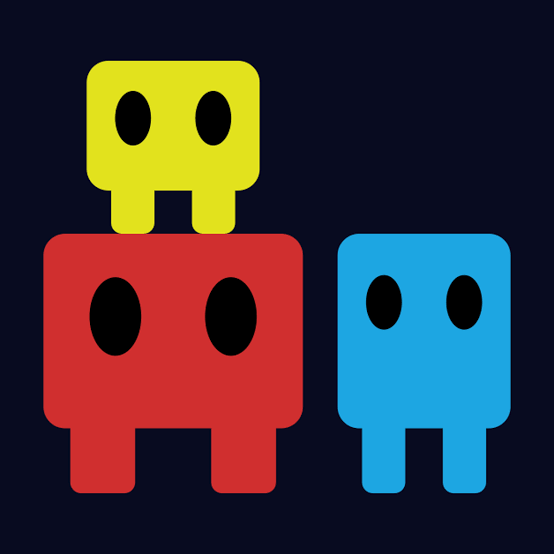
Big Tall Small is a puzzle-platform game by Robert Alvarez where you control three differently sized characters called Big, Tall, and Small. All three need to reach the shared exit, but each has different physical traits that make certain parts of a level easier for one character and difficult for another.
The idea looks simple at first. After playing a few stages, though, I found that moving the characters in the wrong order can create more problems than the obstacles themselves. The most useful habit is to look at the whole puzzle before moving anyone and decide which character needs to act first.
| Game Detail | Information |
|---|---|
| Game | Big Tall Small |
| Developer | Robert Alvarez, rob1221 |
| Genre | Puzzle Platformer |
| Gameplay | Character switching, platforming, logic puzzles |
| Main Characters | Big, Tall, Small |
| Controls | WASD or Arrow Keys, Down, Space, Enter, R, Esc or B |
| Supported Poki Devices | Desktop, Phone, Tablet |
| Original Release | November 2020 |
| Armor Games Release | November 23, 2020 |
| Poki Release | October 2021 |
| Latest Poki Update | October 2022 |
| Levels | 24 |
| Current Poki Rating | 4.1 |
| Current Poki Votes | 137K+ |
| Multiplayer | Single-player |
The developer’s own itch.io page describes Big Tall Small as a puzzle-platformer where multiple characters with different sizes and traits must all reach the same exit. Armor Games credits the developer as Rob1221, while Poki uses his name Robert Alvarez.
How Big Tall Small Works
Each level contains three characters.
You can control only one at a time.
Your task is to switch between them and use their differences to solve the level.
A typical puzzle may involve:
- Moving a crate
- Reaching a high platform
- Passing through a narrow opening
- Activating a switch
- Collecting a key
- Opening a door
- Avoiding a level hazard
- Getting all three characters to the exit
The important part is that one character normally cannot complete everything alone.
The level is designed around cooperation between the three characters, even though one player controls all of them.
Big Tall Small Controls
The official developer page lists these controls:
- WASD or Arrow Keys: Move
- Down Arrow, Spacebar, or Enter: Switch character
- R: Reset level
- Esc or B: Go back
These controls are consistent across the developer’s itch.io page, Armor Games, and Poki.
The control list is small, which lets most of the challenge come from solving the puzzle rather than remembering buttons.
Meet Big, Tall, And Small
The three characters are named after their shapes.
They are not simply different-looking versions of the same character.
Their physical differences affect what they can do within the puzzles.
That is the central mechanic of the whole game.
Big
Big is the large red character.
Big’s size and strength make this character particularly useful around heavy objects and obstacles that the smaller characters cannot handle in the same way.
Community documentation for the game records that Big can push crates and has a different interaction with some stage hazards than Tall and Small.
When a level contains a large movable block, I usually check whether Big needs to reposition it before moving the other characters.
That can prevent getting another character trapped behind the object later.
Tall
Tall is the narrow blue character.
The character’s height gives Tall access to areas that can be difficult for the other two.
Tall becomes useful when a puzzle involves:
- Higher platforms
- Vertical positioning
- Reaching areas above another character
The difference is easy to understand visually.
If something looks too high for Small or awkward for Big, Tall is usually worth testing.
Small
Small is the short yellow character.
Its compact size makes it useful for narrow spaces and routes that the larger characters cannot enter.
That creates one of the game’s most common puzzle ideas.
A passage may be visible to everyone, but only Small can actually travel through it.
When I see a narrow gap, I now check Small before trying complicated alternatives.
Everyone Must Reach The Exit
Getting one character to the exit does not finish the puzzle.
The goal is to get all three characters there.
Poki, Armor Games, and the creator’s own page all describe the shared exit as the central objective.
This rule changes how you should solve levels.
A route that works for Small may leave Big unable to continue.
A platform that Tall can reach may still require another character to activate something elsewhere.
The solution needs to work for the whole group.
Character Order Matters
This became one of the biggest lessons for me.
Imagine that Big needs to move a crate.
If Small walks through the area first and ends up on the wrong side, moving the crate afterward might make the puzzle harder.
The game regularly asks you to think about order.
Instead of asking:
What can this character do now?
Ask:
What needs to happen first so everybody can finish?
That small change makes later puzzles much easier to understand.
Switch Characters Often
Switching characters is not a penalty.
It is the main mechanic.
You may move Big only a few steps, switch to Tall, move Tall into position, then control Small.
Do not try to finish one character’s entire route before touching the others.
Many levels work better when the characters take turns.
Look At The Whole Level First
Before moving, I like to spend a few seconds scanning the level.
Look for:
- Exit locations
- Crates
- Narrow gaps
- High platforms
- Keys
- Doors
- Buttons
- Portals
- Other puzzle objects
Then decide which character appears to match each problem.
This saves a surprising amount of resetting.
Crates Become Part Of The Puzzle
Movable crates appear as the game progresses.
Historical game documentation identifies Big as the character able to push these boxes.
A crate may need to be moved:
- Away from a path
- Toward a useful position
- Onto part of the level
- Out of another character’s route
Before pushing, check what is behind it.
Moving a crate is easy.
Putting it back in exactly the right place may not be.
Keys And Locked Doors
Some levels introduce keys and locked doors.
These create a sequence problem.
You may be able to see the exit, but reaching it requires opening another route first.
That means you need to work backward:
Where is the locked path?
Where is its key?
Which character can reach the key?
Then you can plan the movement order.
Character-Specific Routes
Later puzzles can include paths that only work for a particular character.
This reinforces the idea that Big, Tall, and Small are not interchangeable.
A route may seem blocked until you realize that it was designed for one specific member of the group.
Whenever a path seems strangely shaped, I check whether one character’s dimensions fit it better.
Buttons Need Planning
Buttons and switches can change parts of a level.
The important question is often not simply how to activate one.
It is whether the character activating it needs to stay there while someone else moves.
This is where character switching becomes especially useful.
Leave one character in the correct position.
Switch.
Move another character through the newly opened route.
Then return later if needed.
Do Not Move Big Too Far Too Early
Big takes up more space.
That can make positioning especially important.
Moving Big into a narrow or central area too early can sometimes make the route less convenient for the others.
I prefer solving Small’s narrow-space problems and Tall’s vertical problems mentally first before committing Big to a difficult position.
Small Is Often Useful For Scouting
Because Small fits through tighter spaces, this character can sometimes reach areas the others cannot immediately access.
That makes Small useful for understanding what lies beyond a narrow section.
If I am unsure what a corridor leads to, I often check it with Small before reorganizing the rest of the level.
Tall Helps With Vertical Puzzles
When the puzzle starts spreading upward instead of sideways, Tall becomes more important.
A high route may look unreachable when you are controlling Big or Small.
Switching to Tall can immediately make the intended solution clearer.
The game does a good job of teaching you to associate character shape with level shape.
Reset Is Part Of Solving The Puzzle
Press R to restart a level.
I would not treat reset as failure.
Puzzle-platform games often teach through experimentation.
If you move a crate into an unusable position or send a character somewhere they cannot return from, restart and try the sequence differently.
A quick reset is better than spending several minutes trying to repair a broken solution.
Big Tall Small Has 24 Levels
Preserved game documentation records 24 levels, with the completion message appearing after Level 24. Player comments on the developer’s own itch.io page also refer to completing all 24 stages.
The stages gradually introduce new puzzle ideas rather than presenting every mechanic immediately.
This makes the early levels useful training for later ones.
Level 13 Received A Developer Fix
The creator’s itch.io page contains an update note saying the starting positions in Level 13 were adjusted and a visual issue involving keys was fixed.
That is a useful first-party confirmation that the developer continued refining the original browser release after launch.
It also shows that the game was not simply uploaded and abandoned immediately.
The Levels Teach Mechanics Gradually
Earlier puzzles focus on understanding the three characters.
Later stages combine more elements.
Instead of explaining every system through a long tutorial, the game lets the level layouts teach you what each character can do.
That suits the minimalist presentation.
The screen remains simple while the puzzle itself becomes more complicated.
Minimal Graphics Help The Puzzle
Big Tall Small uses a clean visual style.
Characters and level objects are easy to distinguish.
That matters because you spend a lot of time studying the arrangement of the stage.
Highly detailed scenery would make switches, doors, gaps, and platforms harder to read.
The simple presentation keeps attention on the solution.
It Is An HTML5 Game
The creator’s itch.io page identifies Big Tall Small as an HTML5 release.
The developer also lists tools used to make it, including:
- Stencyl
- OpenFL
- Inkscape
- LMMS
That means it was designed for modern browser technology rather than being an old Flash title converted later.
This separates it from many older browser platform games.
Original Release Was In 2020
There is a small release-date difference between platforms.
A contemporary puzzle-game blog featured Big Tall Small on November 2, 2020, calling it Robert Alvarez’s latest puzzle-platformer.
Armor Games published its version on:
November 23, 2020.
Newgrounds also lists Big Tall Small among Robert Alvarez’s 2020 games.
The safest historical summary is therefore:
Original release: November 2020
Poki Release Came Later
Poki currently lists:
Release: October 2021
Latest update: October 2022.
These are Poki platform dates rather than the original game’s first release.
The clearer timeline is:
Original browser release: November 2020
Poki release: October 2021
Latest Poki update: October 2022
Who Created Big Tall Small?
Big Tall Small was created by Robert Alvarez, who publishes games under the name rob1221.
The developer’s own itch.io page uses rob1221, while Poki uses Robert Alvarez.
Armor Games also credits the game directly to Rob1221.
These are the same developer identity rather than two different creators.
Robert Alvarez Makes Puzzle Games
Robert Alvarez has built a large catalogue of compact browser puzzle games.
His official itch.io profile includes titles such as:
- Big Tall Small
- Shoot to Slide
- Color Count
- Consumable Controls
- RRGGBB
- Wall Roller
Poki also connects him with several well-known logic and platform games.
Other Robert Alvarez Games
The current Poki listing highlights:
- Teleport Jumper
- Block Toggle
- Isotiles
- Chessformer
- Resizer
as other Robert Alvarez puzzle games.
If you like Big Tall Small because of character switching and compact logic puzzles, his other browser games use similarly focused ideas built around one central mechanic.
Big Tall Small And Resizer
Resizer is another Robert Alvarez puzzle-platform title.
Both games use character size as part of puzzle solving, but they approach it differently.
Big Tall Small gives you three separate characters with different sizes.
Resizer builds its puzzles around changing size as part of the platforming mechanic.
That makes the games feel related without being copies of each other.
Big Tall Small And Teleport Jumper
Teleport Jumper focuses on changing position through teleportation.
Big Tall Small instead focuses on choosing which character should handle each obstacle.
Both reward looking at the whole stage before acting.
The difference is the tool you use to solve the puzzle.
In one game it is teleportation.
In Big Tall Small it is character switching.
Supported Devices
Poki currently lists:
- Desktop
- Phone
- Tablet
as supported devices.
The developer’s original itch.io release is described as an HTML5 browser game with keyboard input.
Because different hosts can adapt controls differently, the safest description is that Poki currently supports all three device classes, while the original release was designed around keyboard controls.
Is Big Tall Small Multiplayer?
No.
Big Tall Small is a single-player puzzle-platformer.
You control all three characters yourself by switching between them.
The developer’s itch.io page explicitly tags the game as Singleplayer.
The three-character design may look cooperative, but it does not require three human players.
Current Big Tall Small Rating
Poki currently shows approximately:
4.1 from more than 137,000 votes.
The exact vote total changes as more players rate the game.
It should therefore be treated as a current platform snapshot rather than a permanent figure.
The creator’s itch.io page separately shows a 4.5 out of 5 rating from its own much smaller user group.
Those two platform ratings should not be combined.
Common Big Tall Small Mistakes
The first mistake is moving characters without planning their order.
Another is forgetting that all three need to reach the exit.
Players can also move a crate too early and accidentally make another route harder.
Another common problem is trying to force the wrong character through an obstacle instead of switching.
Finally, some players avoid resetting even when the current arrangement clearly cannot work.
Restarting quickly is part of learning the solution.
A Better Way To Solve Each Level
Start by looking at the entire stage.
Identify narrow spaces for Small.
Find high areas where Tall may help.
Look for heavy objects or large obstacles that suggest Big.
Then check the exit and work backward.
Decide which character needs to move first.
Position that character.
Switch to the next.
If the solution becomes impossible, press R and change the order.
The basic rhythm is:
inspect → assign → move → switch → reassess → exit
Related Categories
Big Tall Small fits naturally into:
- Puzzle Games
- Platform Games
- Brain Games
- Block Games
- Logic Games
- HTML5 Games
- Single-Player Games
Poki currently categorizes it primarily as a platform and puzzle game.
What Makes Big Tall Small Different?
Big Tall Small does not give one character a long list of powers.
Instead, it spreads the abilities across three simple characters.
Big handles problems that suit its size.
Tall helps with vertical sections.
Small reaches compact spaces.
Then every stage asks you to combine those differences in the correct order.
That creates puzzles where the solution is not only about where to go.
It is about who should go there first.
The controls remain simple throughout the game, but the relationships between the characters, crates, doors, switches, gaps, and shared exit gradually become more demanding.
That is why such a visually simple game can produce surprisingly thoughtful puzzles.




Reviews
There are no reviews yet.