
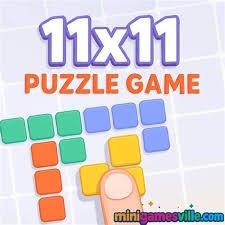
11-11 is a block puzzle game by BuyHTML5 where you place different shapes onto an 11×11 board and try to complete full horizontal or vertical lines. Finished lines disappear, creating more space and allowing the run to continue.
The rules looked very simple when I first started, but the game became much harder once several awkward shapes appeared together. The biggest improvement for me was stopping the habit of filling every convenient gap. Leaving flexible open areas for future pieces matters much more than making the board look tidy after every move.
| Game Detail | Information |
|---|---|
| Game | 11-11 |
| Developer | BuyHTML5 |
| Genre | Puzzle |
| Gameplay Style | Block placement and line clearing |
| Board Size | 11×11 |
| Main Objective | Complete rows and columns while preserving space |
| Controls | Click or tap, drag and place |
| Supported Devices | Desktop, Phone, Tablet |
| Browser Release | September 2020 |
| Latest Verified Update | November 2020 |
| Current Rating | About 4.0 |
| Current Votes | 198K+ |
| Multiplayer | Single-player |
An 11×11 Board Gives You More Room To Plan
The title comes directly from the board.
You work with an 11 by 11 grid, giving you more space than many smaller block-placement puzzles.
Famobi’s current game catalogue describes the objective as placing different shapes on the 11×11 grid and building complete vertical or horizontal lines.
That extra room does not mean you can place pieces carelessly.
The board can still fill quickly if small unusable gaps start appearing between larger shapes.
How 11-11 Works
The main gameplay loop is straightforward:
choose a block → find an open area → place it → complete lines → clear space → continue
When a row or column becomes completely filled, it clears from the board and gives you more room for future shapes.
The goal is to continue for as long as possible while building your score.
There is no complicated character movement, level map, or story system.
Most of the challenge comes from spatial planning.
11-11 Controls
The current browser controls are very simple.
Desktop
- Click and hold a block.
- Drag it onto the board.
- Release to place it.
Phone And Tablet
- Touch a block.
- Drag it into position.
- Lift your finger to place it.
Poki currently lists 11-11 as supported on desktop, phone, and tablet.
Modern web interfaces can use pointer events to handle mouse and touchscreen input through the same general interaction system. The MDN Pointer Events documentation provides technical background on this type of browser input.
Complete Rows And Columns
You do not need to match colors to clear the board.
The important thing is filling an entire straight line.
That line can be:
- horizontal
- vertical
Once every square in that line is occupied, the completed line disappears.
This immediately creates more usable space.
Famobi specifically confirms full horizontal and vertical lines as the central clearing mechanic.
Look At All Your Available Shapes First
One habit helped me more than anything else:
Do not place the first block simply because it fits.
Look at all available shapes before committing.
A small piece may fit almost anywhere.
A long or bulky shape may have only one useful position.
That means the hardest-to-place piece often deserves attention first.
Save Large Open Areas
Large pieces become difficult when the board breaks into lots of tiny gaps.
I try to keep at least one wider open area available.
That gives future shapes somewhere to go even if their layout is awkward.
A board with lots of empty squares can still be effectively full if those squares are separated into unusable spaces.
Avoid Single-Square Holes
A one-square hole looks harmless.
It can become annoying if none of the upcoming pieces can fill it.
Several isolated holes are even worse because they take up board space without helping you complete a line.
Whenever possible, I place blocks so empty areas remain connected rather than scattered.
Corners Can Be Useful For Awkward Pieces
The corners are often good places for shapes with clear right-angle structures.
Placing them there can help keep the middle open.
I would not fill every corner automatically, though.
A corner may also become useful later for a larger piece.
The main idea is to avoid wasting versatile central space when a shape fits naturally along an edge.
Keep The Center Flexible
The middle of the 11×11 board is useful because many different shapes can reach it.
If you pack the center too early, later pieces may have nowhere flexible to go.
I usually prefer letting less adaptable shapes occupy edges while keeping some central room available.
That makes the next few turns easier to manage.
Try To Build More Than One Line At Once
A good placement can help several unfinished lines.
For example, one shape may contribute to:
- one horizontal row
- one vertical column
If both are nearly complete, a future piece could clear several parts of the board in quick succession.
That is usually more useful than building one isolated line while ignoring everything around it.
Do Not Chase One Line Too Aggressively
It is easy to become focused on finishing a nearly complete row.
That can lead to poor placements elsewhere.
If the required shape is not available, forcing unrelated blocks around that line may create more problems than the eventual clear solves.
I prefer keeping the unfinished line available while continuing to build the rest of the board sensibly.
Leave Room For Long Shapes
Long straight blocks need continuous space.
They become especially difficult to place when the board has many scattered gaps.
I try to preserve at least one open horizontal or vertical section whenever possible.
You may not need it immediately, but having that space available can save a run later.
Small Pieces Are More Valuable Than They Look
Tiny blocks do not clear much space by themselves.
What makes them useful is flexibility.
A small piece can often:
- finish a nearly complete row
- close a narrow gap
- finish a column
- connect several larger placements
That flexibility means I usually avoid wasting the smallest blocks in completely open areas unless there is a good reason.
Think About The Shape After This Move
A placement can look perfect now and still create trouble later.
Before dropping a block, I ask:
What open shape will remain afterward?
If the answer is a strange narrow pocket that very few pieces can use, I look for another position.
This forward planning is where 11-11 becomes much more interesting than simply filling squares.
Line Clears Create Breathing Room
Completing a line does more than increase score.
It changes the entire board.
A crowded section can suddenly become open again.
That is why setting up future clears matters so much.
The healthiest board is usually not the emptiest one at this exact moment.
It is the one with several realistic ways to clear space soon.
Avoid Dividing The Board Into Separate Pockets
A large wall of blocks can split the empty space into two smaller areas.
That can reduce your options.
A shape that would fit easily if the empty squares were connected may fit nowhere once they are separated.
I try to keep pathways between open sections until there is a clear reason to close them.
You Cannot Rely On Rotation
Established versions of this block-puzzle format present pieces in fixed orientations rather than letting you freely rotate every block before placement.
That makes planning more important because you need to work with the shape exactly as it appears.
Instead of thinking:
I can rotate this later
it is safer to ask:
Where does this particular orientation fit now?
There Is No Need To Rush
11-11 is based on planning rather than reaction speed.
There is no racing opponent waiting for you to move.
That gives you time to compare possible placements.
For me, spending a few extra seconds before placing a difficult block saves much more time than restarting after the board becomes trapped.
Day And Night Visual Modes
Famobi’s current catalogue also mentions a choice of minimalist visual styles, including day and night mode.
These options change the presentation rather than the puzzle rules.
The board size, block placement, and line-clearing objective remain the same.
It is a small feature, but useful if you prefer a lighter or darker game screen.
Phone Play Works Well With Drag Controls
Poki currently supports phone play.
The simple drag-and-drop interaction translates naturally to touchscreen controls.
There are no tiny virtual movement buttons to manage.
You select a shape, drag it onto the 11×11 board, and release it.
The main consideration is visibility because a finger can temporarily cover part of the board while positioning a piece.
Tablet Gives The Grid More Space
Tablet play uses the same touch controls but gives the grid more physical screen area.
That can make it easier to inspect:
- small gaps
- nearly complete lines
- available large spaces
- possible future placements
The rules remain identical.
The larger display simply makes spatial planning more comfortable.
Desktop Offers Precise Placement
On desktop, mouse control makes it easy to position shapes carefully.
The larger display can also help when the board becomes crowded.
Because the puzzle is based on planning rather than quick movement, desktop play feels calm and precise.
Who Created 11-11?
The current Poki listing credits BuyHTML5 as the developer.
BuyHTML5 is also credited with other browser games including:
- Tiny Fishing
- Hypersnake
- Dunkbrush
- Ice Cream, Please!
- 99 Balls
Poki’s current BuyHTML5 records connect these titles to the same developer.
Famobi Also Lists The Game As Eleven Eleven
Famobi currently lists the title as Eleven Eleven rather than using only the numeric form 11-11.
Its description matches the same block puzzle:
- 11×11 grid
- different block shapes
- horizontal line clearing
- vertical line clearing
- high-score play
- day and night themes
This provides useful independent confirmation of the game’s core mechanics.
Release And Latest Update
The current Poki timeline is:
Release: September 2020
Latest Update: November 2020
For Mopoga, I would keep both fields separately.
September records the browser release shown on the current platform.
November 2020 is the latest currently listed update.
Current 11-11 Rating
The current browser listing shows approximately:
4.0 from 198,656 votes.
That number can continue changing.
For an evergreen Mopoga table, 198K+ votes is safer than presenting one exact total as permanent.
Is 11-11 Multiplayer?
11-11 is best described as a single-player puzzle game.
The current game listings focus on personal score and board management rather than online competition or local two-player play.
You play against the limitations of the board and your own previous results.
Common 11-11 Mistakes
The first mistake is placing blocks in the first open space you notice.
The second is creating too many isolated gaps.
Another problem is filling the center too early.
I also found that concentrating entirely on one nearly complete row can damage the rest of the board.
Finally, avoid assuming that having many empty squares automatically means you have plenty of room. Their shape and connection matter just as much as the total number.
A Better Way To Approach Each Turn
This routine works well for me:
- Check every available block.
- Identify the hardest shape to place.
- Look for nearly complete rows or columns.
- Protect at least one large open region.
- Avoid isolated single-square gaps.
- Place the block.
- Check how the remaining space changed.
- Look for the next possible line clear.
- Repeat without rushing.
The key is thinking about future shapes rather than only the piece currently in your hand.
More Puzzle Games On Mopoga
If you like block placement but want falling sand-style physics, Sandtris on Mopoga combines block shapes with grains that break apart after landing.
For a puzzle focused on completely filling shaped boards, Lines to Fill on Mopoga asks you to drag colored paths until every available space is covered.
You can also try Planet Merge on Mopoga if you prefer physics-based merging, where matching planets combine into larger celestial bodies.
11-11 Compared With Sandtris
Both games involve planning where shapes should go, but their boards behave very differently.
11-11 uses:
- fixed grid squares
- manual block placement
- completed rows and columns
- an 11×11 board
- no falling-block timing pressure
Sandtris uses:
- falling pieces
- sand-like physics
- loose grains
- more unpredictable movement
11-11 gives you more direct control over placement.
Sandtris introduces physics that can change what happens after a piece lands.
11-11 Compared With Lines To Fill
Lines to Fill is more structured.
Each level has a specific board that must be completely solved.
11-11 works as an ongoing high-score puzzle.
That means:
Lines to Fill: find the intended solution.
11-11: preserve space for as long as possible.
The controls are similarly simple, but the goals are very different.
What Makes 11-11 Different?
11-11 takes a very small ruleset and creates a long-term planning challenge from it.
You drag shapes.
You complete rows and columns.
Those lines disappear.
Then you keep going.
The interesting part is everything that happens between those simple actions.
Every placement changes the shape of the empty space.
A move that earns no points now may create the perfect line clear later.
A move that looks useful immediately may trap the board several turns afterward.
For me, the game became much more manageable when I stopped asking, “Where does this block fit?” and started asking, “What kind of board will this placement leave behind?”
Related Categories
11-11 fits naturally into:
- Puzzle Games
- Block Games
- Brain Games
- Logic Games
- Classic Games
- Mouse Games
- Mobile Games
- Single-Player Games
Poki currently places it primarily under Puzzle Games and also associates it with block, logic, brain, classic, mobile, and easy-game categories.
About 11-11
11-11 is a block puzzle game by BuyHTML5 where you arrange different shapes on an 11×11 board and complete full horizontal or vertical lines.
Finished lines disappear, giving you more room and allowing the run to continue.
The browser version supports desktop, phone, and tablet through simple drag-and-drop controls.
Its rules take only a few moments to understand, but higher scores depend on protecting open space, avoiding awkward gaps, and thinking several placements ahead.

Reviews
There are no reviews yet.