

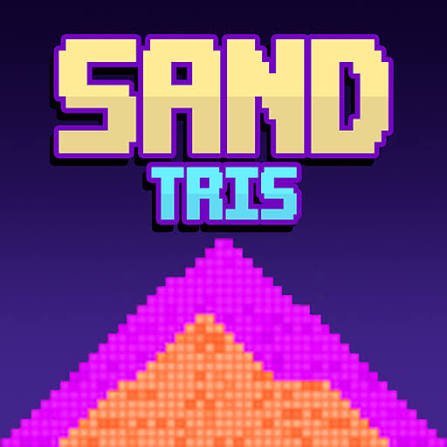
Sandtris is a falling-block puzzle game by A-Team where solid coloured pieces turn into loose sand after landing. Instead of clearing a row by filling it with rigid blocks, you need to connect the same colour all the way from the left side of the board to the right.
That one change makes familiar block-puzzle habits much less reliable. I initially tried arranging pieces into neat shapes, but the sand immediately shifted into gaps and changed the board. I had better results once I started watching where the grains actually settled instead of where the falling block appeared to land.
| Game Detail | Information |
|---|---|
| Game | Sandtris |
| Developer | A-Team |
| Genre | Puzzle, Block |
| Gameplay Style | Falling blocks, sand physics and colour matching |
| Controls | Mouse movement or horizontal swipe |
| Supported Devices | Desktop, Phone and Tablet |
| Release | September 2024 |
| Latest Verified Update | August 2026 |
| Current Rating | 4.0 |
| Current Votes | 61K+ |
| Main Modes | Classic and Speed-Up |
| Multiplayer | Single-player |
| Main Objective | Connect one colour from left to right to clear it |
The current browser listing identifies A-Team as the developer and describes Sandtris as its first game on that platform.
The Blocks Do Not Stay As Blocks
Sandtris begins like a familiar falling-block puzzle.
A coloured piece drops from above.
Then something different happens.
As soon as it lands, the solid shape breaks apart into individual grains of sand.
Those grains can:
- Slide down slopes
- Fall into small gaps
- Settle between other colours
- Change the shape of the pile
- Create or break possible connections
This means the final position matters more than the original shape.
A piece that looks perfectly placed while falling may spread into an entirely different arrangement after landing.
How You Clear Sand
The main objective is not creating a completely filled horizontal row.
You need the same colour to form a continuous connection from the left side of the board to the right.
When that happens, the connected sand clears and creates more room.
That changes the way I look at every piece.
Instead of asking:
Where does this block fit?
I ask:
Which colour needs help reaching the other side?
That simple change makes Sandtris much easier to understand.
Sandtris Controls
The controls are deliberately small.
Desktop
Move the mouse left or right to choose where the falling piece should land.
Phone And Tablet
Swipe left or right to position the piece.
The current browser version supports desktop computers, phones, and tablets.
Web pages can track pointer movement from different input devices through browser pointer events. The MDN Pointer Events documentation explains how mouse, pen, and touch input can be handled through a shared event model.
Stop Thinking In Perfect Rows
Traditional falling-block games encourage tidy horizontal arrangements.
Sandtris often punishes that instinct.
The sand is loose.
It does not respect the clean outline of the original block.
If you drop a piece onto an uneven surface, some grains can move downward while others remain higher.
I found it more useful to think about:
- Colour routes
- Empty channels
- Low areas
- Barriers created by other colours
- Where loose sand is likely to flow
That is very different from simply completing a geometric row.
Build Colour Bridges
The easiest way I found to understand the scoring system is to think of each colour as trying to build a bridge across the board.
Imagine you already have red sand touching the left side.
If another red area sits near the centre, your next red piece may help connect those regions.
You do not necessarily need a perfectly straight line.
The important part is continuity from one side to the other.
That makes irregular piles useful.
A messy-looking section can still be close to clearing if the same colour is almost connected across the board.
Watch Where The Sand Settles
One of my early mistakes was looking away as soon as a piece landed.
That is exactly when useful information appears.
The grains can continue moving.
A narrow gap might fill.
A colour may unexpectedly reach another section.
Or a pile may shift enough to block the route you were preparing.
I now wait briefly for the sand to settle before planning the next drop.
That gives a much clearer picture of the board.
Different Colours Can Trap Each Other
Mixed colours create most of the difficulty.
Suppose red sand is almost connected across the screen.
A thick layer of blue sand may split that route.
You then have several choices:
- Build the red connection around it
- Clear another colour first
- Use future pieces to fill a different route
- Avoid making the obstruction larger
This is why placing every piece in the lowest available area is not always helpful.
Sometimes the lowest position is exactly where you need to keep a colour pathway open.
Classic Mode
Classic Mode is the more predictable way to learn Sandtris.
The falling speed stays manageable enough for you to study:
- How pieces break apart
- How sand moves
- How colour connections form
- Where gaps develop
I would start here.
The physics take a few rounds to understand, especially if you are used to solid block puzzles.
Once you can predict roughly where grains will settle, the faster mode makes much more sense.
Speed-Up Mode
Sandtris also includes a mode where the blocks gradually fall faster.
The puzzle rules do not change.
Your available thinking time does.
That makes poor planning more expensive.
I found that the best preparation for Speed-Up mode was not practising faster mouse movements.
It was learning to read the board faster.
Knowing which colour I wanted before the next piece arrived reduced the amount of last-second correction.
Do Not Chase Every Immediate Clear
Clearing sand feels useful because it creates space.
But an immediate small opportunity is not automatically your best move.
Sometimes dropping a piece for one quick connection can damage a much larger route you were building elsewhere.
Before committing, I check:
- Which colour is closest to connecting?
- What will happen to the other colours?
- Will the grains fall into a useful area?
- Am I blocking an important channel?
The game becomes much more strategic once you look beyond the next single clear.
Empty Space Is A Resource
Open space is not wasted space in Sandtris.
It gives the falling grains somewhere to move.
If the entire lower board becomes packed with mixed colours, creating clean connections becomes much harder.
I try to preserve at least one useful low channel rather than filling every gap immediately.
That space can later help one colour travel underneath another pile.
For another Mopoga puzzle where positioning matters more than speed, Big Tall Small asks you to arrange three characters in the correct order to solve compact levels.
Why Sand Physics Change The Puzzle
The main difference between Sandtris and rigid block games is gravity acting on many small particles rather than one permanent shape.
Once the piece breaks apart, each grain can settle according to the space around it.
That produces slopes and irregular piles instead of clean block towers.
You therefore cannot rely entirely on the original falling shape.
The useful skill is predicting the final pile.
This is also why two drops that look similar can create noticeably different results when the surface beneath them is different.
Create Slopes On Purpose
Slopes are not always a problem.
They can guide future sand toward a useful area.
If one side of the board is too high, placing a piece slightly farther away may allow some grains to roll toward the lower section.
I started getting better results when I stopped trying to flatten every surface.
Sometimes an uneven pile creates exactly the path a future colour needs.
Bad Ice-Cream 2 Uses Blocks Very Differently
Bad Ice-Cream 2 is another Mopoga puzzle game where the board changes while you play, but its blocks behave very differently.
There, you intentionally create and break solid ice walls to control routes through a maze.
Sandtris removes that certainty.
Its pieces turn into loose material, so the board changes according to where the grains can fall.
Both games reward looking ahead, but Sandtris is much less predictable at the moment a piece lands.
Mobile Play Needs Controlled Swipes
Sandtris works well with touch because horizontal positioning is the main input.
Still, I found large repeated swipes less useful than short controlled adjustments.
On a smaller screen, it is easy to move farther than intended when trying to reposition quickly.
The W3C guidance on target size explains why sufficient size and spacing help reduce accidental activation on touchscreen interfaces.
That principle is useful here because mobile play depends heavily on accurate finger input.
Plan Before The Piece Gets Low
Waiting until a falling block is almost at the pile leaves very little time for correction.
I try to decide the general target area while the piece is still high.
Then I only need small left or right adjustments near the bottom.
A useful sequence is:
identify colour → inspect route → choose area → position → watch it settle
This feels much calmer than constantly dragging from one side to the other.
The Highest Pile Is Not Always The Biggest Problem
A tall pile looks dangerous because it occupies visible space.
But mixed colours near the bottom can be worse.
They can prevent useful connections across the board even when there is plenty of height remaining above them.
I therefore pay attention to the structure of the lower pile first.
A low messy foundation can make every later piece harder to use.
A taller but well-organised colour route may be much easier to clear.
Common Sandtris Mistakes
Planning around the original block shape
The piece breaks into sand after landing, so its final arrangement matters more.
Trying to create normal solid rows
The goal is connecting one colour across the entire width.
Ignoring the settling animation
Grains can continue moving after initial contact.
Mixing colours without watching pathways
One colour can cut through another colour’s possible route.
Filling every low gap immediately
Some empty channels are useful for future sand flow.
Waiting too long to position a piece
Deciding early leaves more room for small corrections.
Is Sandtris Like Tetris?
The falling-piece idea is clearly familiar, but the solving method is substantially different.
Traditional Tetris keeps tetrominoes solid and clears complete horizontal rows.
Sandtris turns its pieces into grains and asks you to connect matching colours across the width of the board.
That means skills do not transfer perfectly.
Knowing how to stack falling pieces still helps with spatial awareness.
However, expecting the shapes to remain rigid can actually create bad decisions.
The sand is the mechanic you need to learn.
Who Created Sandtris?
Sandtris was created by A-Team.
The current platform listing describes it as A-Team’s first game released there.
There are other independently made games online with similar Sandtris names, so developer attribution matters.
For the browser edition described on this page, the verified developer is A-Team.
Release And Latest Update
The current browser listing gives:
- Release: September 2024
- Latest Update: August 2026
That makes August 2026 the newest platform update I could verify for this version.
Supported Devices
Sandtris currently supports:
- Desktop
- Phone
- Tablet
Because control is based primarily on horizontal mouse movement or swiping, the basic interaction transfers naturally between these device types.
The W3C WCAG 2.2 specification also covers input considerations for pointer and touch-based interfaces, including target sizing and dragging interactions.
Current Sandtris Rating
The current platform rating is approximately:
4.0 from 61,000+ votes.
Ratings and vote totals can change as more people play, so this is best treated as a current platform snapshot.
Is Sandtris Multiplayer?
The current browser version is best described as single-player.
Its focus is clearing colours, managing the sand pile, and improving your own run rather than competing directly against another player.
The available game listing does not describe local or online multiplayer for this edition.
Another Mopoga Puzzle To Try
If you want another game built around changing the level itself, Bad Ice-Cream 2 lets you break and create ice blocks while navigating maze-like stages.
For a more logic-focused challenge, Big Tall Small replaces falling particles with character switching, crates, doors, and compact platform puzzles.
These are useful alternatives because they still reward planning, but neither uses Sandtris’s loose-grain physics.
What Makes Sandtris Different?
Sandtris changes one familiar rule and lets that rule reshape the whole puzzle.
The blocks fall normally.
Then they stop being blocks.
Once the pieces become sand, neat geometry gives way to flowing grains, slopes, gaps, mixed colours, and constantly changing routes.
That makes every drop partly about placement and partly about prediction.
For me, the game started making sense when I stopped trying to create a perfect board.
The better goal was creating useful colour paths inside an imperfect one.
Related Categories
Sandtris fits naturally into:
- Puzzle Games
- Block Games
- Brain Games
- Physics Games
- Colour-Matching Games
- Casual Games
- Mobile Games
- Single-Player Games



Reviews
There are no reviews yet.