
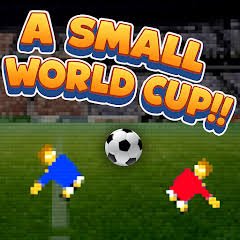
A Small World Cup is a physics-based football game from Rujo Games where each side controls a single floppy ragdoll player. Instead of running normally, you drag your character, aim the movement, and release to launch it toward the ball. The goal is simply to score more than the other side and progress through short tournament matches.
What made the game click for me was realizing that maximum power is not always useful. A small controlled movement can keep your player between the ball and your own goal, while a wild launch can leave the whole side open.
| Game Detail | Information |
|---|---|
| Game | A Small World Cup |
| Developer | Rujo Games |
| Creator | Marco Rossi |
| Genre | Sports, Football |
| Gameplay | 1v1 ragdoll football |
| Controls | Click or tap, drag, release |
| Supported Devices | Desktop, Phone, Tablet |
| Poki Release | November 2019 |
| Latest Verified Poki Update | August 2025 |
| Current Rating | 4.4 |
| Current Votes | 487K+ |
| Main Modes | Practice, tournaments, Golden Goal |
| Multiplayer | Solo and local 2-player |
Poki currently identifies Rujo Games as the developer and describes A Small World Cup as a one-on-one football game built around dragging a ragdoll player across the pitch.
How A Small World Cup Works
That single character effectively handles everything.
You need to:
- Reach the ball
- Push it toward the opponent’s goal
- Protect your own goal
- Recover after each launch
- Score before the other side does
The character does not move like a traditional football-game player.
You drag and release it.
That creates the loose physics that define the game.
A Small World Cup Controls
The control system is very simple.
Desktop
- Hold the left mouse button
- Drag the player to aim
- Release to launch
Phone And Tablet
- Touch and hold the player
- Drag to aim
- Lift your finger to release
Poki confirms mouse dragging as the desktop control and officially supports desktop, phone, and tablet.
One Player Does Every Job
There are no separate forwards, midfielders, defenders, and goalkeepers.
Your one ragdoll character does all of those jobs.
That creates an important trade-off.
Move too far forward and your own goal may be exposed.
Stay too defensive and you may struggle to create scoring chances.
I found that the most useful position is often one that lets you attack the ball without completely abandoning the goal.
Do Not Launch At Full Power Every Time
Long drags create bigger movements.
That can help when the ball is far away.
But maximum power also reduces control.
If your character flies past the ball, you may need another full movement just to return.
Shorter launches are often easier when the ball is close.
The game rewards timing more than constant power.
Read The Ball Before Moving
It is tempting to move as soon as your turn or opportunity appears.
I prefer checking three things first:
- Where the ball is
- Where my player will land
- Whether the move leaves my goal open
That quick check makes the physics feel less random.
Use The Player As Both Attacker And Defender
Because there is only one character, defending does not require a separate goalkeeper.
Your own player needs to cover that space.
If the opponent has a clear approach toward your goal, keeping your character between the ball and the net can be more useful than immediately trying to attack.
Once the ball moves away, you can switch back to an attacking position.
Rebounds Matter
The ball can bounce off:
- Players
- Ground
- Goal areas
- Other parts of the pitch
That makes rebounds an important part of each short match.
A movement does not end when your character first reaches the ball.
The resulting bounce may create the next scoring opportunity.
I found it useful to watch where the ball is likely to go after contact rather than only aiming at its current position.
Practice Mode Is The Best Starting Point
A Small World Cup includes a Practice Mode.
This is the easiest place to understand:
- How far different drags move the player
- How the ball reacts
- How quickly the ragdoll falls
- How much control you have near the goal
A few practice attempts can make tournament matches feel much less unpredictable.
World Cup Tournament
The World Cup structure lets you choose a team and progress through tournament matches.
Winning keeps the run alive.
The aim is to reach the final and win the cup.
Poki specifically describes choosing a team, entering the World Cup, selecting a difficulty, and working through the tournament.
More Competitions Were Added Later
Rujo Games continued adding tournament options after the original release.
The developer’s official itch.io page says the special Poki version received seven competition types in January 2023:
- World Cup Classic
- World Cup 2022
- Euro Cup
- America Cup
- Euro Clubs
- Italian Clubs
- English Clubs
The same page later documented Copa America 2024 and Euro 2024 additions in another updated version.
That gives the game more replay value than playing one tournament repeatedly.
Golden Goal Mode
Golden Goal changes the rules completely.
The first goal wins.
There is no need to build a large score.
Poki specifically highlights Golden Goal as a mode where one successful goal is enough to continue.
That makes defensive mistakes much more costly inside the game.
One bad launch can decide the entire round.
Play More Carefully In Golden Goal
Normal matches give you some chance to recover after conceding.
Golden Goal does not.
That means I would avoid risky opening movements.
Keep the player in a position where one unexpected rebound cannot immediately leave the goal uncovered.
Then attack when the ball position looks useful.
Difficulty Settings
Poki confirms that A Small World Cup lets players select a difficulty before tournament play.
Starting on an easier setting is useful for understanding the unusual movement.
Once the drag-and-release system feels predictable, increasing difficulty gives the same tournament format more challenge.
Local Two-Player Mode
The current Poki version can be played solo or with two local players.
That means another person can play on the same device.
This should not be confused with remote online matchmaking.
The multiplayer experience is built around sharing the current device rather than joining a distant opponent through a lobby.
Solo Play Uses Computer-Controlled Opponents
If you play alone, the other side is controlled by the game.
This is the normal way to work through tournaments and practise the mechanics.
The short matches make solo play easy to restart if a tournament run ends early.
The Ragdoll Physics Create Most Of The Fun
The player does not always land neatly.
Bodies tumble.
The ball rebounds unpredictably.
A move that looked perfect can produce a strange result.
That unpredictability is intentional.
Poki describes the game around ragdoll characters and short chaotic matches.
The physics make each goal feel a little different.
Do Not Fight The Physics Too Much
Trying to make every movement look precise can become frustrating.
The game is designed around loose movement.
I found it better to think in terms of useful positions rather than perfect control.
If the player lands somewhere that still protects the goal or keeps pressure on the ball, the move can still be successful.
Small Adjustments Can Be Better
When your character is already close to the ball, a large drag can create unnecessary movement.
A small launch can:
- Tap the ball forward
- Keep the character nearby
- Preserve defensive position
- Set up another rebound
This is one of the easiest ways to make the game feel less chaotic.
Watch Where You Land
The ball matters, but your player’s landing position matters too.
Suppose you send the ball toward the opponent’s goal.
If your character also lands far away from your own goal, a rebound may immediately create trouble.
Try to think about both parts of the movement.
Where does the ball go?
Where do you go?
Defending The Center Helps
When you are unsure what the opponent will do, staying nearer the useful central space can give you options in both directions.
You can react toward your goal.
You can also move toward the ball.
That is often better than sitting directly against one edge of the pitch without a reason.
Do Not Chase A Ball That Is Already Coming Back
Because the ball can rebound, moving toward it immediately is not always necessary.
Sometimes it is already returning toward your side.
A poorly timed launch can send your player past it.
I found it useful to wait a brief moment and read the bounce before committing to another movement.
Short Matches Encourage Replays
A Small World Cup is built around quick games.
That makes tournament losses easier to accept because starting another attempt does not involve a long setup.
You choose a team and try again.
This suits the simple physics system well.
The game is more about repeated short matches than one long football simulation.
National Teams And Clubs
Different versions of the game offer both national-team and club-style competitions.
Rujo Games’ official update history confirms national competitions such as World Cup and Euro Cup alongside Euro Clubs, Italian Clubs, and English Clubs.
That lets you change the tournament theme without changing the basic control system.
Phone And Tablet Play
Poki currently supports both phones and tablets.
The drag-and-release mechanic fits touchscreens naturally.
There is no need to recreate a complicated keyboard layout on mobile.
You simply use your finger instead of a mouse.
Desktop Play
Desktop uses the mouse.
The larger screen can make it easier to judge:
- Ball position
- Goal space
- Player angle
- Drag distance
I find desktop useful when learning how much power different drags create.
Who Created A Small World Cup?
A Small World Cup was created by Rujo Games.
Poki says Rujo Games is based in Milan, Italy.
Google Play’s current developer information identifies the developer behind the app as Marco Rossi in Italy.
Rujo Games also publishes its own updates through the official itch.io page.
Other Games From Rujo Games
Poki currently connects Rujo Games with:
- Sling World Cup
- A Small World Cup 2
Both keep the studio’s focus on simple physics-driven football games.
A Small World Cup 2
Rujo Games later created A Small World Cup 2.
Poki lists the sequel as a June 2026 release.
It keeps the ragdoll football concept but adds more progression, including over 280 player cards, packs, additional teams, and expanded local multiplayer support.
That makes the original A Small World Cup the simpler starting point.
A Small World Cup Vs A Small World Cup 2
The first game focuses mainly on:
- Drag-and-release movement
- Short 1v1 matches
- Tournament play
- Golden Goal
- Simple team selection
The sequel adds a larger collection and roster system.
If you prefer the quickest version of the idea, the original remains the simpler choice.
Release And Update History
Poki currently lists:
Release: November 2019
Latest update: August 2025.
The developer’s own itch.io page also documents significant updates in later years, including:
January 2023: expanded Poki competition selection
June 2024: Copa America 2024, Euro 2024, and new navigation options on an updated version.
For the Mopoga details table, November 2019 and August 2025 are the clearest current Poki dates.
Current A Small World Cup Rating
The current English Poki listing shows approximately:
4.4 from more than 487,000 votes.
The exact number can rise as more people rate the game.
It should therefore be treated as a current platform snapshot rather than a permanent figure.
Is A Small World Cup Multiplayer?
Yes, but the important detail is the type.
A Small World Cup supports:
- Single-player
- Local two-player
Poki directly describes it as playable solo or with two players.
It should not automatically be described as a remote online matchmaking game.
Common A Small World Cup Mistakes
The first mistake is using full power for every movement.
Another is chasing the ball while leaving your own goal completely open.
Players can also move before understanding where the next rebound is heading.
Another common problem is focusing only on the ball and forgetting where the ragdoll itself will land.
Golden Goal adds another mistake: taking a large unnecessary risk when one conceded goal immediately ends the match.
A Better Way To Play
Start in Practice Mode.
Learn how far a short drag moves the player.
Then test longer launches.
Once the controls feel predictable, enter a normal tournament.
Try to keep your player between the ball and your goal when defending.
Attack when the ball position gives you a clear chance.
After normal tournament play feels comfortable, try Golden Goal or another competition.
The basic rhythm is:
read → aim → drag → release → watch rebound → reposition
Related Categories
A Small World Cup fits naturally into:
- Football Games
- Soccer Games
- Sports Games
- Physics Games
- Ragdoll Games
- Two-Player Games
- Local Multiplayer Games
- Mobile Games
Poki currently places it primarily under Sports Games.
What Makes A Small World Cup Different?
A Small World Cup removes almost everything normally found in a football game.
There is no full team of eleven players.
There are no complicated dribbling combinations.
There is no long tactical menu.
Each side gets one floppy player.
You drag.
You release.
Then the physics decide part of what happens next.
Practice, multiple tournaments, different difficulty settings, Golden Goal, and local two-player support add variety without making the control system complicated.
That simplicity is the reason the game works so well for short sessions. You can understand the controls almost immediately, but learning how much power to use and where your character will land takes much longer.
Reviews
There are no reviews yet.