

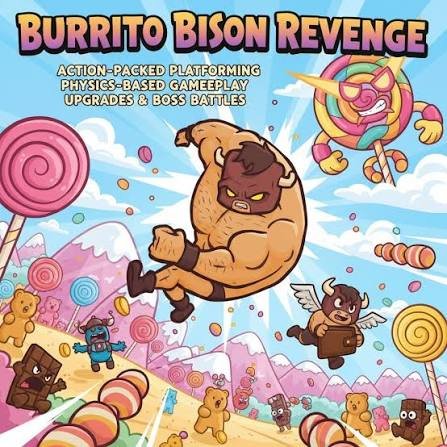
Burrito Bison Revenge is a physics-based launch game from Juicy Beast where Burrito Bison returns to Candy Land after realizing his wallet is missing. Instead of controlling normal movement, you launch him from a wrestling ring, keep his momentum alive by bouncing through gummy bears, collect money, and gradually buy upgrades that help each new run go farther.
The controls are extremely small, but the progression is not. My biggest early mistake was using the slam ability whenever it became available. It works much better when the landing area is useful, because a poorly timed slam can reduce momentum instead of extending the run.
| Game Detail | Information |
|---|---|
| Game | Burrito Bison Revenge |
| Developer | Juicy Beast |
| Genre | Action, Arcade |
| Gameplay Style | Physics launching, upgrades, distance progression |
| Main Controls | Mouse click |
| Alternative Control | Spacebar |
| Players | Single-player |
| Original Browser Release | February 26, 2012 |
| Kongregate Update | March 14, 2012 |
| Perspective | 2D side-scrolling |
| Game Modes | Main progression and Survival mode |
| Original Technology | Flash |
Kongregate records February 26, 2012 as the original release and March 14, 2012 as the last listed update on that platform. MobyGames independently records the browser release as February 27, 2012.
Why Burrito Bison Returns To Candy Land
The sequel begins after Burrito Bison has already escaped Candy Land.
He returns to normal life and goes shopping, only to realize that his wallet is missing. The story sends him back into the gummy-filled world to retrieve it.
Juicy Beast later described the lost wallet as the main motivation behind Burrito Bison Revenge when discussing the history of the series.
The story is deliberately simple.
It mainly gives the repeated launches a reason to continue while the upgrade system provides the actual long-term progression.
How Burrito Bison Revenge Works
Every run starts with Burrito Bison inside a wrestling ring.
Your first job is timing the launch.
After entering the main course, Burrito travels automatically. You then use well-timed slams and interactions with gummies to keep him moving.
Your run becomes slower when momentum drops.
Eventually, the attempt ends and the money collected during that run can be used for improvements.
Then you launch again.
That loop is the heart of the game:
Launch → travel → collect money → upgrade → launch farther.
Flipline’s archived game page describes the sequel around additional gummies, wrestling, barriers, powers, and upgrades.
Burrito Bison Revenge Controls
The original controls are intentionally simple.
- Mouse click: Launch Burrito Bison
- Mouse click during flight: Use a rocket slam
- Spacebar: Can also be used for the same main action in some browser versions
Kongregate’s original instructions simply describe the control system as mouse-based, while surviving browser versions also document Spacebar support.
The MDN MouseEvent documentation explains how browsers register mouse actions such as clicks.
Because there is only one main action, improvement comes almost entirely from timing.
The Launch Sets Up The Entire Run
The first launch matters more than it initially appears.
A stronger opening gives Burrito more speed before he reaches the main field.
That extra momentum can make the first part of the run much easier.
I would not rush this part.
Watch the launch indicator carefully and try to activate it near its strongest point.
Starting badly does not make a run impossible, but it means you need to recover momentum sooner.
Rocket Slams Need A Target
The slam ability sends Burrito downward.
It is useful when there is something helpful beneath him.
The mistake is treating the ability like something that should always be used immediately.
Before slamming, check what is below.
If the landing creates another useful bounce or interaction, the slam can extend the run.
If Burrito hits an empty section badly, you may lose more speed than you gain.
That makes the slam a positioning decision rather than just an attack button.
Gummies Help Maintain Momentum
Gummy bears are not simply background characters.
They are part of the physics system.
Bouncing through them can help keep Burrito moving and provide money for upgrades.
Different gummy types can behave differently, which means the best route is not always simply staying as high as possible.
Sometimes a useful gummy below your current path is worth targeting because it creates another burst of momentum.
This is where the game starts becoming more deliberate than it first looks.
Special Gummies Change A Run
Burrito Bison Revenge expanded the original game with more special gummy types.
Juicy Beast and contemporary game listings describe the sequel as adding more special gummies and more progression systems than the first game.
Special gummies can create unusual effects that change your speed or movement.
The important lesson is learning what each one does.
At first, they can feel random.
After several runs, you start recognizing which ones are useful in specific situations.
That knowledge makes later runs more consistent.
Money Is The Main Progression Resource
Money collected during a run can be spent on upgrades.
That is what gives failed attempts value.
You may not reach your final objective, but the run can still make the next attempt stronger.
I like this structure because progress does not depend entirely on completing a level.
Even a mediocre run can contribute toward:
- Better launches
- Better movement
- Stronger abilities
- More useful effects
- Longer future runs
The key is not judging progress only by distance.
Your upgrade economy matters too.
Upgrades Change Future Runs
Burrito Bison Revenge includes a larger upgrade system than the original game.
MobyGames describes expanded purchasable power-ups as one of the sequel’s key additions.
The upgrades gradually reduce some of the limitations that make early runs difficult.
This creates a useful decision:
Do you save for an expensive improvement or buy several smaller ones first?
I prefer upgrades that improve consistency before chasing more specialized effects.
A reliable benefit helps on almost every run.
A narrow upgrade may only matter under specific conditions.
Distance Is Not The Only Thing To Watch
It is easy to concentrate entirely on how far Burrito has travelled.
That can hide the reason a run is working.
A strong attempt usually combines:
- Good launch timing
- Useful gummy interactions
- Smart slam timing
- Momentum preservation
- Upgrade benefits
If a run suddenly improves significantly, try to notice why.
That is more useful than simply celebrating the larger distance.
You may have discovered a better timing pattern that can be repeated next time.
Momentum Is The Real Resource
Money matters between attempts.
Momentum matters during them.
Once Burrito becomes too slow, recovering becomes more difficult.
That means many decisions can be reduced to one question:
Will this help me keep moving?
A useful slam does.
A good gummy bounce does.
A strong special interaction does.
A badly timed ground impact does not.
Thinking this way made the game much easier for me to understand.
Barriers Mark Major Progress
Burrito Bison Revenge includes large barriers or doors that need to be broken through as you progress farther into Candy Land.
These give the game more structure than a completely endless distance challenge.
Flipline’s archived description specifically mentions additional doors to break through as one of the sequel’s expanded features.
Early runs may not have enough power to pass every barrier.
That is intentional.
Upgrades gradually make these milestones more achievable.
Repeating Runs Is Part Of The Design
Failing a launch is not really a restart from zero.
Your money and upgrades carry progress forward.
That makes repetition part of the progression system.
The useful approach is to give each run one small purpose.
Maybe you want enough money for an upgrade.
Maybe you want to reach a particular barrier.
Maybe you want to understand a special gummy better.
Having one goal makes repeated attempts feel less random.
Boss Encounters Add Variety
Burrito Bison Revenge also expands the series with larger encounters and special situations.
Contemporary records describe bosses and unusual opponents as part of the sequel’s broader progression.
These moments break up the normal launching rhythm.
They also reward understanding the game’s timing rather than relying entirely on upgrades.
A stronger character helps, but recognizing what the encounter expects still matters.
Survival Mode Extends The Game
After completing the main progression, Burrito Bison Revenge includes a Survival mode.
This shifts the focus more heavily toward travelling as far as possible and extending the run.
Archived browser records describe Survival mode as an additional challenge available after finishing the main game.
This gives upgrades more value even after the main objective is complete.
Instead of asking whether you can finish, the question becomes how long you can keep the run alive.
Original Flash Game And Modern Browser Play
Burrito Bison Revenge was originally built during the Flash era.
That creates an important difference between the original game and modern browser access.
Adobe officially ended support for Flash Player on December 31, 2020. The Adobe Flash Player end-of-life information explains why original Flash content no longer runs natively in modern browsers.
Some modern sites use Flash emulation to preserve older games.
For example, current browser listings describe Burrito Bison Revenge as running through Ruffle emulation rather than the original Flash Player.
So the game itself is from 2012 even when a modern website makes it playable today.
Who Created Burrito Bison Revenge?
Burrito Bison Revenge was developed by Juicy Beast, a game studio based in Montréal, Canada.
Juicy Beast’s own site calls the Burrito Bison series among its best-known games and specifically confirms that Burrito Bison Revenge was released in 2012.
The studio’s official press information also identifies Burrito Bison Revenge as one of its most successful action games.
Juicy Beast is also known for games including:
- Burrito Bison
- Knightmare Tower
- Toto Temple Deluxe
The developer later returned to the franchise with Burrito Bison: Launcha Libre.
Burrito Bison Revenge Vs Burrito Bison
The first Burrito Bison established the launch-based structure.
Revenge keeps that idea but expands almost every part of it.
The sequel includes:
- More gummy types
- More upgrades
- Additional barriers
- Expanded progression
- More special interactions
- A larger overall journey
Juicy Beast describes the franchise as a classic launcher series and identifies Revenge as the 2012 follow-up.
For someone deciding between them, the original is the cleaner introduction.
Revenge is the better fit if you want more progression systems.
Release Date Explained
Reliable sources place the browser release at the end of February 2012.
Kongregate records:
Release: February 26, 2012
Latest Kongregate update: March 14, 2012
MobyGames records:
Browser release: February 27, 2012
The one-day difference is likely caused by platform or date-recording conventions.
The safest summary is therefore:
Original release: February 2012
That avoids creating false precision where two established records differ slightly.
Is Burrito Bison Revenge Multiplayer?
Burrito Bison Revenge is a single-player game.
MobyGames records one-player support, while the original Kongregate listing is built entirely around individual progression and upgrades.
There is no requirement to join an online lobby or wait for another player.
That suits the repeated-run structure well because a failed attempt can immediately become the start of another one.
Common Burrito Bison Revenge Mistakes
The first mistake is wasting rocket slams.
The second is ignoring what lies below Burrito before committing to a downward move.
Another mistake is expecting upgrades alone to solve every weak run.
Better upgrades help, but poor timing can still waste momentum.
I would also avoid judging an attempt purely by whether it reaches a new distance record.
A run that earns enough money for an important upgrade can still be valuable.
A Better Way To Progress
I would separate progression into three goals.
First, improve launch timing.
Second, learn how the common gummy types affect momentum.
Third, spend upgrades on the areas that repeatedly stop your runs.
This makes improvement easier to understand.
If you launch well but still lose speed quickly, the problem is probably not the opening.
If you consistently reach a barrier but cannot break through it, upgrades may be the more important next step.
Separating these problems prevents you from changing everything at once.
Related Categories
Burrito Bison Revenge fits naturally into:
- Arcade Games
- Launch Games
- Physics Games
- Action Games
- Upgrade Games
- Distance Games
- Single-Player Games
Its strongest identity is a physics-based launcher because each run is built around turning one initial launch into the longest possible journey.
What Makes Burrito Bison Revenge Different?
Burrito Bison Revenge takes a very small control system and connects it to a surprisingly large progression loop.
One click can launch Burrito.
The same basic input controls slams.
But underneath that simple interface you are managing momentum, special gummies, money, upgrades, barriers, and longer-term progression.
That is why it does not feel like a game you completely understand after one attempt.
The button is easy.
Knowing when to use it is where most of the game lives.


Reviews
There are no reviews yet.