

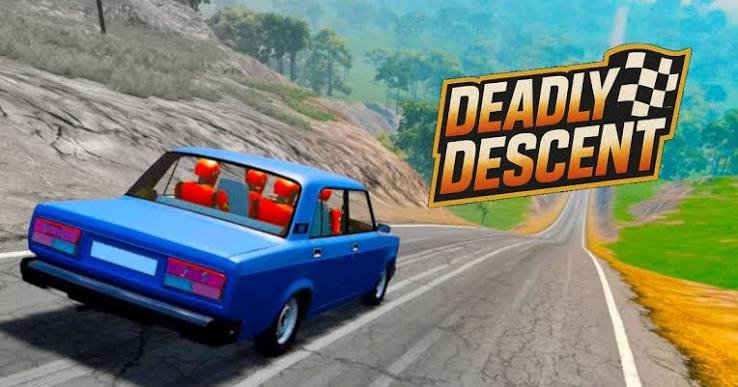
Crazy Descent is a fast downhill racing game where staying on the track can matter just as much as reaching maximum speed. You race along narrow courses suspended high above the ground, steer around obstacles, collide with rival vehicles and try to reach the finish before everyone else.
The first mistake I made was treating every straight section as an invitation to hold the accelerator. That works until the road suddenly narrows or another car pushes across your line. After a few runs, I found that positioning the car before a difficult section was often more useful than trying to correct direction at the last second.
| Game Detail | Information |
|---|---|
| Game | Crazy Descent |
| Developer | AM-Games |
| Genre | Racing |
| Gameplay Style | Downhill racing, obstacle avoidance and vehicle upgrades |
| Controls | W or Up Arrow, A/D or Left/Right Arrows, R |
| Supported Devices | Desktop, Phone and Tablet |
| Browser Release | July 2025 |
| Latest Verified Update | July 2025 |
| Current Verified Rating | 4.2 |
| Multiplayer | No confirmed real-time multiplayer mode |
The current browser listing identifies AM-Games as the developer, July 2025 as both the release and latest-update period, and desktop, phone and tablet as supported devices.
How Crazy Descent Gameplay Works
Each race sends your vehicle downhill along elevated tracks filled with turns, barriers, jumps and competing cars.
Your basic objective is simple: stay on the course and reach the finish ahead of your rivals. The difficult part is that competitors occupy the same narrow road and can interfere with your route. You can also push rival cars toward the edge, although trying too hard to make contact can put your own vehicle in trouble.
Winning races earns cash that can be used to improve the car for later rounds.
That combination makes Crazy Descent slightly different from a traditional circuit racer. You are not only following a racing line. You are constantly judging whether speed, space or contact with another car gives you the safer route forward.
Crazy Descent Controls
The keyboard layout is deliberately small:
- W or Up Arrow: Accelerate
- A/D or Left/Right Arrow: Steer
- R: Restart the race
These are the controls listed for the current browser version.
Simple controls do not necessarily make the driving simple. Because the courses can be narrow, small steering inputs are usually easier to manage than holding a direction key for too long.
For readers interested in how browsers interpret keys such as W, A, D and the arrow keys, the MDN KeyboardEvent reference explains how keyboard input is represented by modern web browsers.
Staying On The Track Matters More Than It Looks
The elevated course design changes how I approach corners.
In a normal racing game, running slightly wide might only cost a little time. Here, poor positioning can remove you from the race entirely. Because of that, I stopped trying to enter every turn at full speed.
One useful habit is making your main steering adjustment earlier than feels necessary. If you wait until the edge of the track is already filling the screen, the correction can become too aggressive.
The same idea applies around other vehicles. I would rather give up a small amount of speed and keep a clean path than become trapped between a rival and the edge.
Rival Cars Are Part Of The Course
Other vehicles are more than moving decorations.
Crazy Descent allows physical interaction between racers, so another car can block your preferred route or become something you push away from the safest section of road. The current game description specifically includes knocking rivals from the course as part of its racing design.
I learned fairly quickly that intentionally chasing every rival is usually a bad trade. Contact is most useful when another car is already beside you and there is space to recover afterward.
If you turn sharply just to hit someone, you can create a bigger problem for yourself than for them.
Winning Races And Improving The Car
Race victories provide cash that feeds into the vehicle-upgrade system.
That creates a straightforward progression loop:
race → earn money → improve the vehicle → enter another race
Upgrades matter because later runs become easier to manage when the car can maintain stronger performance. The game therefore gives you something to work toward beyond simply replaying the same downhill route.
I prefer spending a little time understanding the handling before judging whether an upgrade has helped. When both the vehicle and your driving habits are changing at the same time, it is easy to give the upgrade credit for an improvement that actually came from learning the course.
Why Restarting Quickly Is Useful
The R key restarts a run without requiring a complicated menu sequence.
That sounds like a minor feature, but it fits this type of game particularly well. A mistake near the beginning can leave a run effectively finished, and being able to restart immediately makes practicing the first difficult turn far less frustrating.
Fast restarts are especially useful when you are experimenting with a new approach instead of simply trying to finish.
From a browser-design perspective, games can also use pointer input for touchscreens and other pointing devices. The MDN Pointer Events guide gives useful technical background on how websites handle mouse, pen and touch-style input through a shared browser API.
Crazy Descent On Phone, Tablet And Desktop
Crazy Descent is currently listed for desktop, phone and tablet, so it is not limited to keyboard-based computers.
On desktop, the keyboard controls give you direct steering through W, A, D and the arrow keys. Mobile versions rely on touchscreen input presented by the game.
The underlying decision is less about which device is technically supported and more about which control style you prefer. I find keyboard steering easier when a track demands repeated small corrections, while touch controls can be more convenient for short sessions away from a computer.
The W3C Pointer Events specification provides a deeper technical explanation of how web applications can support different pointer types without requiring completely separate input systems.
What Makes Crazy Descent Different?
Crazy Descent sits somewhere between an obstacle racer and an arcade car game.
Its distinctive part is the combination of:
- narrow downhill tracks
- elevated course sections
- physical interaction with rival vehicles
- environmental obstacles
- quick restarts
- cash rewards
- vehicle upgrades
The races are easy to understand immediately, but survival becomes part of the racing strategy. Being the fastest car does little good if an aggressive correction sends you off the course.
Players who mainly want traditional lap racing may prefer a more conventional racing game. Players who like short races, unpredictable collisions and obstacle-heavy tracks are more likely to appreciate Crazy Descent.
A Better Way To Approach Difficult Sections
When I struggled with a section repeatedly, simply accelerating harder almost never fixed it.
What helped was separating the problem into three parts.
First, I looked at where the vehicle needed to be before the obstacle. Second, I reduced unnecessary steering while passing it. Third, I accelerated harder only after the car was pointing toward a safe section of track again.
That method sounds slower, but it usually produces a faster complete run because there are fewer recoveries.
This is one reason I would not judge Crazy Descent solely from the first race. Early crashes can make the handling look more unpredictable than it becomes once you stop making large last-second inputs.
Who Created Crazy Descent?
AM-Games created Crazy Descent.
The current browser listing describes Crazy Descent as the developer’s first title released on that particular platform. It also currently associates AM-Games with titles including Tear Blocks Down, Sky Race, and BlockCraft.
That developer information is worth separating from similarly named mobile games. There are other products called “Crazy Descent” in app stores, and they should not automatically be treated as the same browser release.
Release And Latest Update
The verified browser listing currently gives July 2025 for both the release date and the latest update.
I could not verify a newer official browser update date, so July 2025 is the date I would use rather than copying newer dates from unrelated websites carrying similarly named games.
That distinction matters because game portals sometimes show the date they added or republished a title rather than the date the developer updated the actual game.
Games And Categories To Try Next
Crazy Descent belongs naturally with Mopoga’s Racing Games collection, especially for players who want speed-focused games with short restartable rounds.
It also fits the Car Games section because vehicle control and car progression form the core of each run.
For a broader selection built around steering and vehicle handling, the Driving Games category is another useful place to continue.
These category links are more useful here than forcing unrelated game names into the article, particularly while Mopoga’s game catalogue is still being expanded.
Browser Performance And Input
Because Crazy Descent is designed to run in a web browser, smooth input can depend partly on browser and device performance.
When a game feels slow, I first check whether the problem is delayed input or a genuinely low frame rate. They can feel similar while playing but have different causes.
Google’s web.dev performance guidance explains how rendering work, responsiveness and other browser-performance factors can affect interactive web experiences.
Closing unnecessary heavy tabs can also help on lower-powered devices, particularly when several media-heavy pages are running at once.
About Crazy Descent
Crazy Descent keeps its idea focused: race downhill, avoid falling, deal with opponents and improve your vehicle between wins.
I think its strongest feature is that the track itself remains the main opponent. Rival cars make each run less predictable, but most failures still come back to your own timing, steering and positioning.
The controls take only a few seconds to understand. Learning when not to steer or accelerate is where most of the skill develops.


Reviews
There are no reviews yet.