

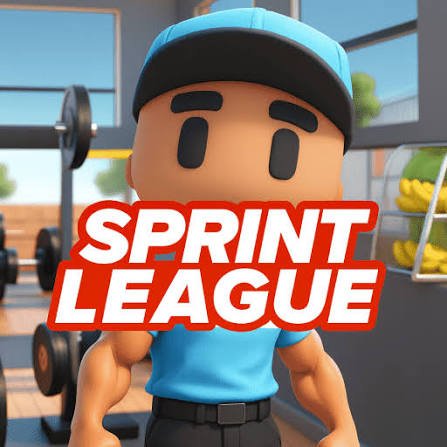
Sprint League is a 3D running and progression game from OnRush Studio where you begin with basic training, improve your runner, compete in races, earn coins, and work toward increasingly faster leagues. The game has grown well beyond its original treadmill-and-racing loop, with newer modes including Red Light Green Light, Tung Tung Tag, Brainrot Tsunami, and Backrooms-style hide-and-seek.
The first thing I learned was that simply running toward every reward is not always the fastest way to progress. Training upgrades matter because stronger stats make later races easier, while coins are better spent on improvements that solve the part of the game currently slowing you down.
| Game Detail | Information |
|---|---|
| Game | Sprint League |
| Developer | OnRush Studio |
| Genre | Sports, .io Adventure |
| Gameplay Style | Running, training, racing, upgrades, extra modes |
| Movement | WASD or Arrow Keys |
| Mobile Controls | Joystick |
| Supported Devices | Desktop, Phone, Tablet |
| Release | November 2024 |
| Latest Verified Update | September 2026 |
| Current Rating | 4.2 |
| Current Votes | 536K+ |
| Progression | Treadmills, coins, shoes, skins, upgrades |
| Extra Modes | Red Light Green Light, Tung Tung Tag, Brainrot Tsunami, Backrooms |
The current platform information identifies OnRush Studio as the developer and confirms that Sprint League supports computers, phones, and tablets.
Start By Training Your Runner
Sprint League does not send you directly into its hardest races.
You begin with a basic treadmill.
Training gives you points that help improve your running ability and eventually open access to better, faster machines.
That creates a clear progression loop:
Train → improve → race → earn coins → upgrade → train again
I would not rush through the early training simply because racing looks more interesting.
The improvements you build there make the competitive sections much easier to handle later.
Sprint League Controls
The main desktop controls are:
- W: Move forward
- A: Move left
- S: Move backward
- D: Move right
- Arrow Keys: Alternative movement controls
- Joystick: Mobile movement
The current browser version confirms both WASD and arrow-key controls, while phones and tablets use a joystick-style system.
For technical background, the MDN KeyboardEvent documentation explains how web applications recognize keyboard input such as WASD and directional keys.
The controls are simple enough that learning the keys is not the hard part.
The bigger challenge is deciding where to move when several objectives appear around you.
Treadmills Drive Early Progress
Training machines are one of the main progression systems.
You begin on a basic treadmill and collect enough points to reach stronger machines.
The better treadmill is not simply a cosmetic change.
It helps push your runner farther through the progression system.
I found it useful to treat each treadmill as a short-term target.
Instead of thinking about reaching the highest league immediately, work toward the next machine first.
That makes progression much easier to follow.
Do Not Ignore Your Stamina Progress
Sprint League describes stamina as one of the central areas you improve before racing.
This is an in-game statistic rather than real-world exercise guidance.
Inside the game, stronger stamina helps your character perform better as the running challenges become more demanding.
If races suddenly feel much harder than the previous ones, returning to training can be more useful than repeating the same race without upgrading.
The mistake is assuming every loss needs a different route.
Sometimes your character simply needs more progression.
Racing Turns Training Into Rewards
After training, you can compete against stronger runners.
Better performances provide coins.
Those coins can then be used for further improvements.
This makes racing different from treadmill training.
Training builds the runner.
Racing tests the runner and generates rewards.
The two systems support each other, so concentrating entirely on only one side can slow your overall progress.
Beating Your Personal Best Matters
Sprint League also encourages you to improve your own race times.
That gives races a useful goal even when you have already completed them.
Instead of judging a run only by whether you won, check whether your time improved.
A slightly cleaner route can make a noticeable difference.
For me, it is easier to improve one section of a race than try to become faster everywhere at once.
If one turn or obstacle repeatedly costs time, concentrate on that area first.
Coins Should Have A Purpose
Coins are earned from racing and other activities.
They can be spent on progression items such as shoes, upgrades, and customization.
I would avoid buying something simply because you can afford it.
Check what currently limits your progress.
If you need more useful performance improvement, prioritize that.
If your stats are already comfortable and you mainly want personalization, cosmetics become more attractive.
Having a target makes coin spending feel much less random.
Shoes Are Part Of Progression
Sprint League allows you to unlock different shoes as you continue playing.
They sit alongside other rewards and improvements in the progression system.
I would treat them as part of the wider upgrade loop rather than expecting one unlock to transform every race.
Your overall development still comes from combining training, racing, and smart upgrades.
Skins Add Customization
Skins let you change the appearance of your runner.
They give you another reason to keep earning rewards even after the basic running mechanics become familiar.
Cosmetics do not replace progression, though.
A new appearance may make your runner look different, but improving the underlying game stats remains more important when you are struggling with harder leagues.
Work Through The Leagues Gradually
Sprint League is built around climbing toward stronger competition.
It can be tempting to focus only on reaching the highest league.
I found smaller goals more useful.
Reach the next treadmill.
Improve one ability.
Win the next race.
Unlock the next useful upgrade.
Then repeat.
This turns what could feel like a long grind into a series of manageable targets.
Red Light Green Light Mode
Sprint League later added a Red Light Green Light mode inspired by the familiar stop-and-go game format.
The important skill here is restraint.
Normal racing encourages forward movement.
A stop-and-go mode punishes moving at the wrong moment.
That means your usual instinct to keep running can work against you.
Pay attention to the current state before moving instead of assuming faster is always better.
Tung Tung Tag Changes The Goal
Another newer mode is Tung Tung Tag.
In this mode, you run from Tung Tung Sahur while collecting coins.
If you are caught, you switch sides and become part of the chasing team.
That creates a different type of movement challenge.
You are no longer concentrating only on reaching a finish line.
You need to:
- Keep distance from the chaser
- Collect useful coins
- Avoid routes that leave you trapped
- Watch how other players move
I would value open space more than one extra coin when the chaser is nearby.
Brainrot Tsunami Adds An Escape Challenge
Sprint League also includes a Brainrot Tsunami mode.
The goal is to collect Brainrots while escaping an incoming tsunami and improving your speed.
This changes the normal progression loop because movement becomes more urgent.
Collectibles still matter, but staying ahead of the hazard matters more.
One mistake is moving sideways for every nearby collectible.
If a pickup forces you too far away from the safest forward route, it may cost more time than it is worth.
Backrooms Mode Changes The Game Again
As of the September 2026 update, Sprint League includes a Backrooms mode built around hide-and-seek in maze-like yellow corridors.
Hiders use the environment to avoid being found, while Tung Tung Sahur characters search the corridors before time expires.
This is a major change from ordinary sprint racing.
Raw running speed is no longer the only useful skill.
Route memory and knowing where corridors connect become much more important.
Learn The Map Instead Of Running Randomly
This becomes especially important in modes with larger environments.
Random movement feels active, but it can repeatedly bring you back to the same area.
I prefer choosing recognizable landmarks and building a rough mental map.
Remember:
- Where the main paths connect
- Where dead ends appear
- Which routes give multiple exits
- Where useful collectibles usually appear
That reduces wasted movement.
Mobile Play Uses A Joystick
Sprint League supports:
- Desktop
- Phone
- Tablet
Mobile players use joystick-style controls rather than physical WASD keys.
The W3C Pointer Events specification explains the common web standard used to handle touchscreen, mouse, and pen input.
The game itself does not fundamentally change on mobile.
The main difference is how you control direction.
I would use smaller joystick movements when navigating tight spaces rather than pushing fully in every direction.
Desktop Gives You Familiar WASD Movement
Desktop players can use either WASD or the arrow keys.
If you already play 3D browser games, WASD will probably feel immediately familiar.
I would pick one control layout and keep using it.
Switching between the arrow keys and WASD during the same session rarely provides an advantage.
Consistency makes directional changes easier once races become faster.
Do Not Treat Sprint League As Real Sprint Training
Sprint League uses terms such as stamina, training, treadmills, and sprinting, but these are game systems.
They are not a simulation of real athletic coaching.
If you are interested in actual sprint competition, World Athletics publishes official information about track and field events, competition rules, and real athletics.
That distinction matters because improving an in-game stamina stat has nothing to do with how someone should train physically.
Sprint League is designed for entertainment and progression.
Who Created Sprint League?
Sprint League was created by OnRush Studio.
OnRush Studio’s official website confirms Sprint League as one of its casual games and says the company is based in Amsterdam, Netherlands. OnRush Studio’s official website also confirms several other games made by the same team.
Other titles from OnRush Studio include:
- Venge.io
- Tribals.io
- Burger Bounty
- Jungle Friends
- Arcane Archer
- Shipo.io
- Eat the World
- MagicLand.io
- Soccer League
- Fishing League
- Build League
This first-party confirmation is more reliable than relying only on copied game listings.
Sprint League And Burger Bounty
Both games come from OnRush Studio, but they focus on very different progression systems.
Sprint League is built around:
- Training
- Running
- Racing
- Movement upgrades
- Extra competitive modes
Burger Bounty focuses more on restaurant management and customer service.
The similarity comes from progression.
Both give you a simple starting point and gradually expand what you can do.
The difference is whether you prefer movement challenges or management.
Sprint League And Venge.io
Venge.io is another OnRush Studio game, but it belongs to a very different genre.
Sprint League uses running, training, and progression.
Venge.io focuses on competitive shooter-style matches.
For readers choosing between them, Sprint League is the better fit when the main appeal is character growth, movement, and short running challenges rather than combat-focused gameplay.
Release And Update History
The current platform timeline is:
Release: November 2024
Latest verified update: September 2026
One localized platform record gives the more precise release date as November 22, 2024.
The September 2026 version includes the newer Backrooms mode, showing that Sprint League has continued receiving substantial content well after its original release.
Earlier 2026 platform snapshots referenced Brainrot Tsunami and Tung Tung Tag before the Backrooms update, which also helps show how the game has changed over time.
Current Sprint League Rating
The current listing shows approximately:
4.2 from more than 536,000 votes.
That total has continued changing as more players vote.
It should therefore be treated as a current platform snapshot rather than a permanent game statistic.
Is Sprint League Multiplayer?
Sprint League includes .io-style and shared competitive modes, but the core game also contains personal training, progression, and best-time challenges.
Some newer modes clearly involve competition or team-style objectives.
Rather than describing the entire game as one single multiplayer format, it is more accurate to say that Sprint League combines individual progression with competitive and shared game modes.
The experience changes depending on which mode you select.
Common Sprint League Mistakes
The first mistake is racing constantly without spending enough time training.
The second is spending coins without knowing which improvement you actually need.
Another mistake is chasing every collectible in modes where maintaining a safe route matters more.
In tag or escape modes, players can also run directly into dead ends because they are concentrating only on the character chasing them.
Finally, do not assume the same strategy works in every mode.
A racing strategy is not automatically useful in Backrooms or Red Light Green Light.
A Better Way To Progress
I would learn Sprint League in this order.
First, understand movement.
Then build the early training stats.
Race enough to earn coins.
Use those coins on a clear progression goal.
After the basic running loop feels comfortable, start spending more time in the extra modes.
This prevents the large number of newer activities from making the game feel confusing.
The original training-and-racing system remains the easiest place to learn how progression works.
Related Categories
Sprint League fits naturally into:
- Running Games
- Sports Games
- .io Games
- Racing Games
- Training Games
- 3D Games
- Progression Games
- Mobile Games
Its current main platform classification is Sports Games, while the game is also presented as an .io adventure because of its shared environments and competitive modes.
More Games From OnRush Studio
Players who like Sprint League may also recognize several games from the same developer.
Soccer League stays closer to sports.
Fishing League uses another progression-focused activity.
Build League moves into building.
Burger Bounty focuses on restaurant management.
Jungle Friends offers a more relaxed simulation style.
OnRush Studio’s official website lists Sprint League alongside its broader casual-game catalogue.
What Makes Sprint League Different?
Sprint League started with a fairly simple running idea.
Train on treadmills.
Improve your stats.
Race.
Earn coins.
Climb the leagues.
The game has since grown into something much broader.
Red Light Green Light changes when you are allowed to move.
Tung Tung Tag turns movement into pursuit.
Brainrot Tsunami adds an escape challenge.
Backrooms turns the game into maze-based hide-and-seek.
That variety means the controls remain simple while the reason for moving keeps changing.
For me, that is the most interesting part of Sprint League now. It is no longer only about becoming faster. It is about learning when speed actually helps.

Reviews
There are no reviews yet.