

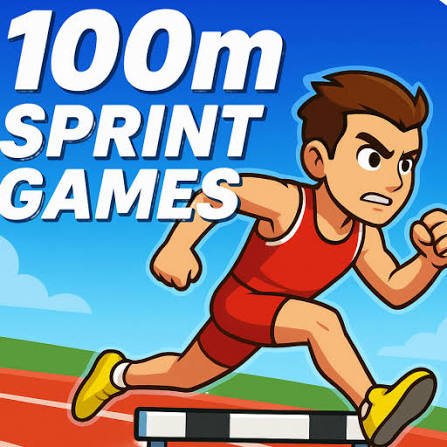
100 Metres Race is a track-and-field sprint game from Code This Lab where the entire challenge comes down to rhythm, speed, and energy management. You choose an international runner, compete in 100-metre races, earn medals from strong finishes, improve your athlete, and gradually move through new locations before reaching the later competitions in Rio.
The controls initially made me think the game would simply reward pressing as fast as possible. That did not work particularly well. Alternating the controls in a steady rhythm kept my runner moving more smoothly, while frantic uneven presses made it harder to maintain pace through the whole race.
| Game Detail | Information |
|---|---|
| Game | 100 Metres Race |
| Developer | Code This Lab |
| Genre | Sports, Running, Racing |
| Gameplay Style | 100-metre sprint races, medals and athlete upgrades |
| Controls | Left and Right Arrow Keys |
| Supported Devices | Desktop, Phone, Tablet |
| Poki Release | March 2019 |
| Latest Verified Poki Update | December 2025 |
| Current Poki Rating | 4.2 |
| Current Poki Votes | 78,000+ |
| Technology | HTML5 and JavaScript |
| Multiplayer | Single-player |
The current Poki listing identifies Code This Lab as the developer, March 2019 as its platform release, and December 2025 as its latest update. It currently supports desktop, phone, and tablet browsers.
The Race Is Simple, But The Rhythm Is Not
Every event is a short 100-metre sprint.
Once the race begins, you alternate the left and right controls to make your athlete run. The faster and more consistently you alternate them, the better chance you have of staying ahead of the other runners.
There are no complicated cornering mechanics or long tracks to memorise.
Your biggest challenges are:
- Starting strongly
- Finding a steady button rhythm
- Keeping enough energy for the full race
- Avoiding a slowdown near the finish
- Improving your athlete between events
I found the final part of the sprint more important than I expected. Starting quickly feels good, but using too much energy early can leave your runner struggling when the other athletes are still maintaining their pace.
100 Metres Race Controls
On desktop, use:
- Left Arrow: One running input
- Right Arrow: The other running input
Alternate between the two repeatedly to move your runner down the track.
The game is also designed for phones and tablets, where equivalent touch controls replace the physical keyboard buttons.
Mozilla’s documentation on KeyboardEvent input explains how browsers detect individual keyboard interactions in web applications and games.
Do Not Just Mash Both Keys
This was the first mistake I made.
It seems logical that hitting both controls as aggressively as possible should produce maximum speed.
In practice, a repeatable left-right pattern is easier to maintain.
I had better results when I concentrated on:
Left → Right → Left → Right
rather than thinking only about pressing faster.
Once that rhythm becomes automatic, you can gradually increase the pace without losing consistency.
The game turns an extremely small control system into a coordination challenge.
Energy Can Decide The Last Part Of A Sprint
Your runner has an energy system that becomes important as races get harder.
Code This Lab’s original game description specifically says that medals help increase your energy as you work toward the championship podium.
That means progression is not simply about repeating the same race with identical statistics.
Your athlete can become better prepared for later events.
I would not judge the entire game by the first race because the progression system gradually changes how competitive your runner can be.
Medals Give Finishing Position More Value
Finishing well earns medals.
Those rewards matter because they contribute to your athlete’s development and help you continue through the competition.
That gives second and third place some value rather than making every non-winning run completely useless.
Still, first place remains the target.
I found that useful psychologically because a close second-place finish becomes information rather than a wasted attempt. You can look at where you slowed down, adjust your rhythm, improve the runner, and try again.
Your First Races Take Place In American Cities
The progression starts in Seattle.
From there, races take you through other locations including:
- San Francisco
- Miami
- New Orleans
Later progression takes the competition toward Rio.
The current game description confirms this location sequence and the goal of completing the American races before travelling to Rio.
Changing locations does not completely replace the sprint mechanic.
Instead, opponents become the bigger concern.
The basic control you learned in the first race remains useful throughout.
Country Choice Gives The Competition A Track-Meet Feel
100 Metres Race lets you represent different national teams.
The current version includes choices such as the United States, Germany, and Russia.
The country selection does not turn the game into a detailed athletics simulation, but it helps create the feeling of an international sprint competition.
That matches the real-world event the game is loosely based on.
According to World Athletics’ guide to the 100 metres, the real event is run entirely in assigned lanes along the straight section of a standard track, with the fastest legal finish determining the winner.
The browser game simplifies those rules heavily and concentrates on sprinting rhythm instead.
Starting Fast Helps, But Finishing Fast Matters More
My early races followed the same pattern.
I would build a lead quickly, concentrate on the runners behind me, and start pressing even faster.
Then my runner’s pace would become less consistent near the end.
A better approach was to think about the sprint in three sections.
Start
Settle into your left-right rhythm immediately.
Middle
Keep the rhythm steady instead of constantly changing speed.
Finish
Push harder only if the runner still has enough energy and an opponent is close.
This is obviously much simpler than real sprint technique, but dividing the race mentally stopped me from panicking whenever another runner moved ahead for a moment.
Real 100-Metre Racing Is Much More Technical
The game deliberately simplifies athletics.
Real competitive 100-metre sprinting involves starting blocks, reaction time, acceleration, maximum velocity, lane rules, and precise finishing technique.
World Athletics explains that elite runners move through several distinct phases from the block start through acceleration and maximum velocity before the finish.
100 Metres Race turns most of that into one simple mechanic: how effectively you can alternate the running controls.
That makes it accessible, but it should not be treated as a realistic sprint simulator.
Athlete Upgrades Become More Useful Later
As the opponents become faster, raw button speed is not the only thing affecting results.
Improving your athlete can help with qualities such as speed and stamina.
This creates a basic progression loop:
Race → earn rewards → improve the runner → enter a harder race.
I prefer spending upgrades after identifying where a race is going wrong.
If I start strongly but fade late, improving endurance makes more sense than simply expecting faster inputs to solve everything.
If I stay consistent but cannot match an opponent’s pace, speed becomes more important.
The Best Restart Is An Informed Restart
Short races make replaying easy.
That can encourage repeatedly restarting without thinking about what went wrong.
I found it more useful to identify one problem first.
Was the start slow?
Did my alternating rhythm break?
Did I lose energy too early?
Did an opponent only pull ahead near the finish?
Once you know that, the next attempt has a clear purpose.
Repeatedly pressing faster without changing anything usually produces very similar results.
100 Metres Race Works Well In Short Sessions
A single sprint does not take long.
That makes the game suitable for short play sessions where you want a clear objective without learning a large control system.
You can complete a race, improve the athlete, and immediately see whether that change helped on the next attempt.
This is also why the upgrade system matters.
Without it, the game could feel like repeating exactly the same ten-second challenge.
Progression gives those short races a larger structure.
Original Technology
100 Metres Race was developed as an HTML5 sport game.
The original Code This Lab marketplace listing states that it was built with HTML5 and JavaScript using CreateJS rather than Construct.
That technology choice helps explain why the game can run directly in modern browsers.
The developer also maintains an official playable 100 Metres Race showcase.
Unlike older Flash games, HTML5 titles do not depend on the discontinued Adobe Flash Player.
Release Date And Latest Update
There are two dates worth separating.
The current Poki edition lists:
- Release: March 2019
- Latest update: December 2025
However, Code This Lab’s commercial HTML5 package existed before the Poki release, and its marketplace record shows the game as an older product with an October 2019 package update.
For Mopoga’s game details table, I would therefore use March 2019 as the Poki release, rather than claiming that March 2019 was necessarily the game’s first appearance anywhere.
That wording keeps the dates accurate.
Who Created 100 Metres Race?
100 Metres Race was developed by Code This Lab SRL, an Italian studio that has produced many HTML5 browser games.
Its catalogue covers sports, board games, arcade titles, and other casual games.
Code This Lab also created sports titles such as:
- Swimming Pro
- Penalty Kicks
- Penalty Challenge
- Classic Bowling
- Foosball
The studio’s original 100 Metres Race product listing describes it as an HTML5 sports game centred on challenging top runners and collecting medals.
Desktop Vs Phone And Tablet
The current browser version supports:
- Desktop
- Phone
- Tablet
Desktop play suits the alternating arrow-key mechanic particularly well because each hand can remain close to one button.
Touchscreens replace those physical inputs with on-screen controls.
I prefer keyboard play for this kind of game because physical keys give clearer feedback when trying to maintain a repeating rhythm.
Mobile is still practical, especially because the game only requires two primary running inputs.
Is 100 Metres Race Multiplayer?
100 Metres Race is a single-player browser game.
The runners beside you are game-controlled opponents rather than people joining the same online race.
That distinction is worth knowing before starting.
The visual setup looks competitive, but the challenge is built around beating the game’s runners and progressing through its events rather than racing live players.
How It Compares With Other Sports Games
100 Metres Race is much simpler than sports games that ask you to manage several actions at once.
There is no aiming system, passing mechanic, complicated movement, or large field to control.
The challenge is almost entirely built around coordination and timing.
Mopoga’s Basketball Stars takes the opposite approach, with movement, shooting, stealing, blocking, and local two-player competition.
If you prefer one mechanic that becomes harder through faster opponents and progression, 100 Metres Race is the more focused format.
Three Things I Would Practise First
Find A Comfortable Rhythm
Do not begin by trying to press at your absolute maximum speed.
Build a rhythm you can maintain.
Watch Your Energy
If your runner repeatedly slows near the end, consider how aggressively you are starting and whether upgrades could help.
Ignore The Other Runners Occasionally
Watching an opponent move ahead can make you change rhythm unnecessarily.
I perform better when I focus on my own controls and only check the field briefly.
These are small adjustments, but this is a game where small timing mistakes make up most of the difficulty.
Current Rating
The current Poki listing gives 100 Metres Race a rating of approximately 4.2 out of 5, based on more than 78,000 votes.
The total changes as additional players vote, so it should be treated as a current snapshot rather than a fixed statistic.
I would also avoid combining it with scores from unrelated websites because each platform has its own voting population and rating method.
Related Categories
100 Metres Race fits naturally into:
- Sports Games
- Running Games
- Racing Games
- Athletics Games
- Sprint Games
- Skill Games
- HTML5 Games
- Single-Player Games
- Mobile Games
Its main identity is a short-form athletics game where rhythm and speed matter more than complicated controls.
More Games From Code This Lab
Code This Lab has produced a broad collection of browser games.
Relevant sports titles include:
- Swimming Pro
- Penalty Challenge
- Penalty Kicks
- Classic Bowling
- Foosball
The current Poki developer listing also associates Code This Lab with Master Chess, Master Checkers, Four in a Row, Battleship War, and several other casual titles.
About 100 Metres Race
100 Metres Race strips the track-and-field sprint down to a very small set of decisions.
You choose a runner, alternate left and right inputs, manage your pace, collect medals, improve the athlete, and work through increasingly difficult sprint competitions.
The biggest lesson for me was that faster button pressing is useful only when I can keep it consistent.
Once I stopped treating every race like a frantic ten-second button mash and concentrated on maintaining the same rhythm from start to finish, the game became easier to understand and my results became much more repeatable.


Reviews
There are no reviews yet.