


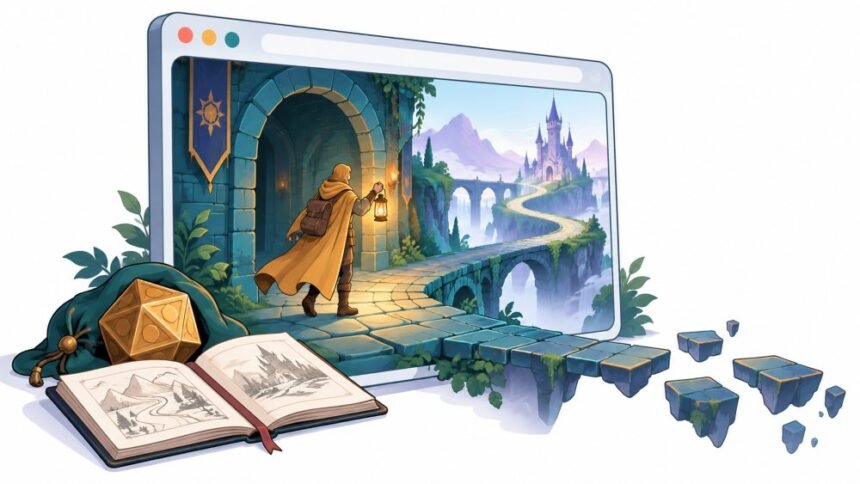
It is eleven at night, your group cancelled again, and you want to play something. So you open a tab, type “I want to play a tired rogue in a rain-soaked port city where the harbour master has gone missing,” and four seconds later you are reading a scene with wet rope, lamp oil and a nervous dock clerk who will not meet your eyes. Nobody had to drive anywhere. Nobody had to agree on a date.
That first hour is good, and anyone who says otherwise has not tried it recently. The trouble starts around session three, when the clerk has quietly changed his name, the knife you took off him is no longer in your pack, and the city guard you swore revenge against greets you like an old friend. This piece covers both halves: what browser-based AI game masters do well, where they break, why they break there, and what you can do about it.
What You Are Actually Talking To When You Open That Tab

Almost every AI dungeon master you can reach from a browser is the same basic sandwich: a large language model in the middle, with layers of software wrapped around it to keep the story straight. The model itself is close to a commodity now. The wrapping is the product, and the wrapping is where quality lives. If you know which layers a tool has bolted on, you can predict its failures before you pay for it.
| Layer | What It Does | What Goes Wrong When It Is Weak |
| The language model | Writes prose, voices characters, improvises | Flat, samey writing and constant purple sunsets |
| The context window | Holds the recent text of your session | Anything older than the window is simply gone |
| Memory or summary system | Compresses old sessions into notes | Details drift, names mutate, motives flip |
| Structured state | Stores hit points, gold, inventory, quest flags outside the prose | Numbers contradict the story within minutes |
| Dice and rules handling | Resolves whether you actually succeed | The model decides outcomes by vibe |
| Moderation layer | Screens content going in and coming out | Scenes stall or soften with no explanation |
This is not new ground for researchers. A team from the University of Pennsylvania and Google framed tabletop play as a dialogue challenge for machines back in 2022, and their central finding still holds: a model that tracks the game state produces better conversation than one working from chat history alone. Most of the difference between a tool that feels magical and one that feels like a slot machine comes down to whether anybody built that state tracking.
What Works Well Enough To Surprise People
Set aside the hype and there is a real list of things these tools do better than a tired human running a game at the end of a long week. They are patient in a way no person can be. They never sigh when you spend twenty minutes interrogating a fishmonger. They answer at two in the morning.
- Improvising around player ideas nobody planned for, including deeply silly ones
- Giving minor characters a voice on demand instead of the same three accents
- Writing scene description that is better than what most of us produce on the spot
- Running a session for one person, with no scheduling and no social cost to quitting early
- Lowering the entry barrier for people who find live tables loud, fast or intimidating
- Acting as a sparring partner for a human game master who wants a second opinion at midnight
That last use is the one with actual study behind it. When researchers built an assistant for human dungeon masters and watched them use it during real play, they found the model produced “high-fidelity text suitable for direct presentation to players,” while the humans kept creative control of the game. Helper, not referee. Hold on to that distinction, because most of what follows is a consequence of ignoring it.
First Thing That Breaks Is Memory
Every model has a context window, which is the amount of text it can look at while writing the next reply. Long sessions overflow it. Tools handle the overflow by summarising older material, and summaries throw away exactly the small specific details that make a campaign feel like yours: the limp, the debt, the promise you made in chapter one.
Worse, stuffing more text in does not fix it cleanly. Work published in the Transactions of the Association for Computational Linguistics on how models actually use long inputs found performance is highest when the relevant fact sits at the very start or the very end of the input, and sags noticeably when it sits in the middle. Your campaign’s middle is precisely where your best plot threads live.
What memory failure looks like in practice, roughly in the order you will meet it:
- An NPC’s name shifts by one letter, then by a whole syllable, then becomes a different person
- Someone you killed walks back into the tavern with no explanation
- Your inventory quietly resets to whatever the model thinks a rogue should carry
- A faction you spent three sessions angering treats you as neutral
- The tone drifts from grim smuggling drama to comic heist without anyone asking for it
Rules Adjudication Is Where The Mask Slips Completely
Prose and bookkeeping are different skills, and language models are lopsided. They write well and count badly. A benchmark built in 2025 to test language models as role playing game engines put it plainly: current systems “can produce engaging stories” but “often struggle to implement consistent, verifiable game mechanics, particularly in long or complex scenarios.”
You will see this as a specific set of behaviours:
- Spell and ability effects invented on the spot, close to the real rule but not the real rule
- Armour class, saving throws and damage applied inconsistently between turns
- Difficulty set after you announce what you want, rather than before
- Dice described as rolled when no dice were rolled at all
- Enemy tactics that collapse the moment you sound confident
The fix is known, and it is architectural rather than clever prompting. When a research team built a dataset of nearly 25,000 real play sessions with true game state attached, models given that structured state produced better output than models given only the conversation. Tools that hold your character sheet in an actual database, and roll actual dice, behave noticeably better than tools that keep everything in the story text. When you are comparing products, that is the single question worth asking first.
Stakes Vanish Before The Rules Do
Here is the failure I think matters most, and it gets discussed least. These models are trained to be agreeable. They are rewarded for helpful, satisfying answers. A game master’s job includes saying no, letting a plan fail, and letting a character die. Agreeableness and refereeing pull in opposite directions.
The result is a table where you always succeed, eventually. Push hard enough and the locked door opens, the guard is persuaded, the fall is survived. Nothing is lost, so nothing is at stake, so nothing is exciting. Players describe it as a story that will not push back.
- Failure gets narrated as partial success almost every time
- Enemies surrender or flee rather than finishing what they started
- Your clever idea is always called clever, even when it is not
- Time pressure is announced but never actually arrives
- Tragedy happens to background characters, never to you
If you take one practical thing from this article, take this: write the right to say no into your own instructions at the start, in explicit terms, and ask for it again every few sessions. It fades.
Solo Play Is Where These Tools Genuinely Earn Their Place
Solo roleplaying is not a new invention made up for AI. Tabletop players have run one person games for decades using oracle systems, journaling prompts and random tables. An AI game master slots into that tradition, and it fits far better than trying to replace a human running a table for five friends.
The people who get real value from solo AI play:
- Players whose group meets once a month and who want something between sessions
- Writers using play as a way to find out what a character does under pressure
- People in time zones or towns with no local group
- Anyone who finds live social play draining but likes the fiction
- Game masters testing a dungeon or a mystery before running it for humans
What Happens When You Add Four Friends
Multiplayer AI sessions are a harder technical problem, and most browser tools handle them poorly. Shared context grows fast, turn order becomes a negotiation, and one person ends up typing for everybody, which quietly makes that person the real game master.
| Aspect | Solo Session | Group Session |
| Context growth | Manageable for hours | Overflows quickly, memory loss arrives sooner |
| Spotlight balance | Not an issue | The model favours whoever typed last |
| Pacing | You set it | Waiting for generation kills momentum |
| Rules disputes | You can shrug and move on | Someone has to arbitrate, and it will not be the AI |
| Social payoff | Low, and that is fine | This is why people came, and the tool cannot supply it |
Strongest Use Today Is Prep, Not Refereeing
If you already run games for people, use the model everywhere except the referee’s chair. It is very good at the unpaid work around the table and unreliable at the work during it.
Jobs it does well:
- Turning your two line idea into five hooks, one of which you will actually use
- Naming things, which is the task most game masters hate most
- Writing the read-aloud description for a room you already designed
- Producing a rumour table, a shopping list, or six townsfolk with one trait each
- Summarising last session into a recap you can read at the table
Jobs to keep away from it:
- Balancing an encounter, because it cannot do the arithmetic reliably
- Any statement of what a published rule says, without checking the book
- Deciding what happens when a player does something surprising
One more point on the material you generate. If you plan to publish or sell what comes out, check the licence of whatever you are building on. Wizards of the Coast, for example, set out its own position on generative art in official products, and community storefronts have their own disclosure rules. Personal use at your own table is a different matter from a product page.
What It Costs Once The Free Tier Runs Out
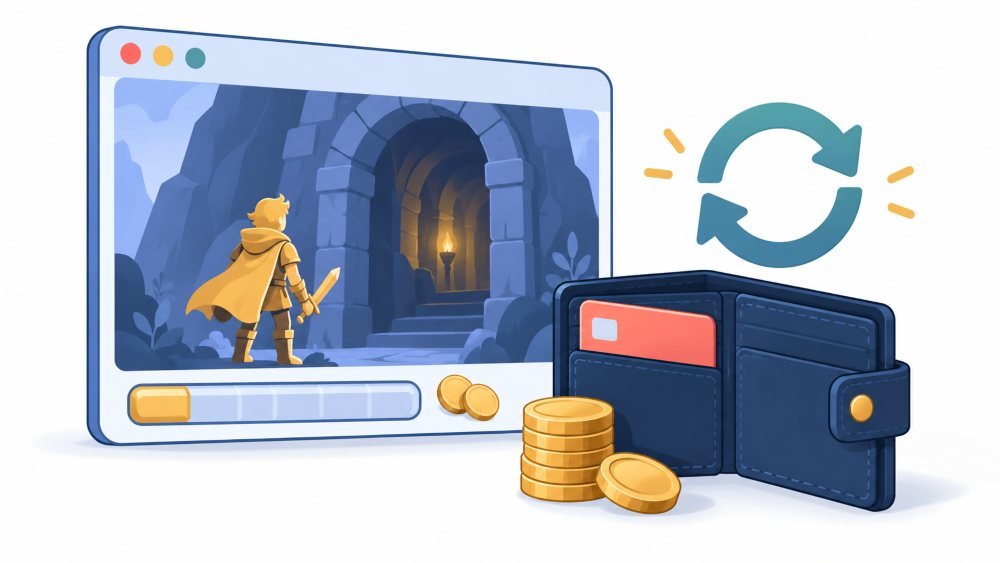
Pricing on these platforms changes often enough that any number printed here would be wrong within months, so treat this as a map of what you are paying for rather than a price list. The important thing to understand is why costs climb with a long campaign: most systems resend a large slice of your story with every single turn, so a mature campaign costs more per message than a fresh one.
| Cost Driver | What It Means In Practice |
| Model tier | Better writing models cost several times more per turn than basic ones |
| Context length | Longer memory means more text resent each turn, and a higher bill |
| Image generation | Portraits and scene art are usually billed separately |
| Message volume | Short back and forth play burns credits faster than longer turns |
| Subscription versus credits | Subscriptions suit steady players, credits suit occasional ones |
A practical note from people who have run the numbers: heavy solo players often find that a subscription plus a cheaper model for routine scenes, saving the expensive model for set pieces, costs less than half of running everything on the best tier.
Safety, Filters And Who Can Read Your Story
This section is less fun and more important than the rest. Text roleplay platforms have a difficult history with moderation, the best known case being the 2021 controversy where a popular AI adventure tool introduced filtering that scanned private stories, which produced both false accusations against ordinary players and a serious breach of trust that the community has not forgotten.
Three things are worth knowing before you type anything personal into one of these tabs:
- Private does not reliably mean private. Assume a human reviewer or an automated system may read flagged content, and check the privacy policy for retention and training use.
- Filters are blunt. Horror, war and grief are normal tabletop subjects, and they trip content systems regularly. Expect interruptions in exactly the scenes you cared about most.
- These systems are persuasive company. In September 2025 the Federal Trade Commission opened an inquiry into companion chatbots and their effects on young users, asking seven major companies about safety testing, data handling and what they tell parents. A game master character that remembers your name and is endlessly warm to you is not neutral, especially for teenagers playing alone at night.
Tabletop culture solved parts of this long before AI arrived, and the tools transfer. The free safety toolkit used by tabletop groups covers lines and veils, a way to stop a scene, and a check-in habit. Setting your own lines in the opening instructions works surprisingly well, and it costs nothing to try.
A Setup That Survives Past Session Three
Most disappointment with these tools comes from treating them like a person who remembers. Treat them instead like a brilliant improviser with no notebook, and hand them the notebook yourself. This is the routine that experienced players converge on.
- Keep a campaign file outside the tool, in any plain document, listing characters, promises, debts and open threads
- End every session by asking for a short state block covering location, injuries, inventory and unfinished business, then paste it back at the start of the next one
- Give people and places distinct names, because similar names collapse into each other fastest
- Roll real dice, or use a dice roller, and tell the model the result rather than asking it to roll
- State in your opening instructions that failure is allowed, that you want consequences, and that the story may refuse you
- Start a new session thread for each new arc, seeded with your campaign file, rather than one endless thread
- Ask for three possible outcomes and pick one yourself when a scene matters
None of this is elegant. All of it works, and it takes about five minutes a session.
A Fifteen Minute Test Before You Pay Anything
Reviews of these tools age badly because the underlying models change monthly. A test you run yourself does not. Here is a short one you can apply to any browser AI game master in a single sitting, which will tell you more than any comparison chart.
| Test | What To Do | Passing Looks Like | Failing Looks Like |
| Continuity | Mention a small detail from thirty turns earlier | Recalls it correctly | Invents a new version of it |
| Refusal | Try something your character plainly cannot do | Says no, or demands a roll | Narrates your success |
| Consequence | Pick a fight you should lose | You are hurt, captured or routed | You win anyway |
| State | Ask for hit points, gold and inventory twice, ten turns apart | Numbers match | Numbers drift |
| Voice | Ask two different characters the same question | Two clearly different answers | The same phrasing twice |
| Handoff | Close the tab, come back the next day | Picks up the thread | Starts a soft reset |
A tool that fails continuity and refusal is a storytelling toy, which is a perfectly good thing to be. Just do not plan a year long campaign on it.
Where This Is Heading
The technical direction is fairly clear, even if timing is not. The gap in these products is state management, not prose quality, and the industry knows it. Licensed narrative platforms have started appearing, with Hidden Door opening browser based early access in August 2025 using public domain and licensed fiction, which at least answers the question of whose worlds these stories borrow.
What looks likely over the next couple of years:
- Game state moved out of the prose and into real databases, with the model asking the database rather than remembering
- Dice, character sheets and rules resolved by actual code, with the model handling only narration
- Tighter integration with virtual tabletops rather than standalone chat boxes
- Smaller models running locally, which removes both the bill and the privacy question
- Clearer licensing, because the legal position on borrowed settings is not settled
The version of this that finally works will probably not look like a chat box at all. It will look like a virtual tabletop that happens to have a very good narrator attached, with the rules handled by software that cannot forget. Until then, what you have in your browser tab is a wonderful improviser with a poor memory and no spine, and knowing that is most of the skill in using it well.
Disclaimer
This article is for general information only and reflects the state of publicly available AI roleplaying tools as of September 2026. Product features, model quality, pricing and moderation policies change frequently, so check the current terms and privacy policy of any platform before use. Nothing here is legal advice regarding copyright, licensing or the commercial use of AI generated material, and readers planning to publish or sell such material should seek qualified advice. Parents and guardians should review the safety settings and age requirements of any AI chat platform before allowing children or teenagers to use it unsupervised.
References
- Callison-Burch, C., Tomar, G. S., Martin, L. J., Ippolito, D., Bailis, S., & Reitter, D. (2022). Dungeons and Dragons as a dialog challenge for artificial intelligence. In Proceedings of the 2022 Conference on Empirical Methods in Natural Language Processing (pp. 9379–9393). Association for Computational Linguistics. https://doi.org/10.18653/v1/2022.emnlp-main.637
- Federal Trade Commission. (2025, September 11). FTC launches inquiry into AI chatbots acting as companions [Press release]. https://www.ftc.gov/news-events/news/press-releases/2025/09/ftc-launches-inquiry-ai-chatbots-acting-companions
- Liu, N. F., Lin, K., Hewitt, J., Paranjape, A., Bevilacqua, M., Petroni, F., & Liang, P. (2024). Lost in the middle: How language models use long contexts. Transactions of the Association for Computational Linguistics, 12, 157–173. https://doi.org/10.1162/tacl_a_00638
- TTRPG Safety Toolkit. (n.d.). TTRPG safety toolkit: Tools and resources for safer tabletop play. Compiled by K. Shaw & L. Bryant-Monk. https://ttrpgsafetytoolkit.com/
- Wizards of the Coast. (n.d.). Generative AI art FAQ. D&D Support. https://dnd-support.wizards.com/hc/en-us/articles/26243094975252-Generative-AI-art-FAQ
- Yu, P., Shen, D., Meng, S., Lee, J., Yin, W., Cui, A. Y., Xu, Z., Zhu, Y., Shi, X., Li, M., & Smola, A. (2025). RPGBench: Evaluating large language models as role-playing game engines (arXiv:2502.00595). arXiv. https://doi.org/10.48550/arXiv.2502.00595
- Zhu, A., Aggarwal, K., Feng, A., Martin, L. J., & Callison-Burch, C. (2023). FIREBALL: A dataset of Dungeons and Dragons actual-play with structured game state information. In Proceedings of the 61st Annual Meeting of the Association for Computational Linguistics (Volume 1: Long Papers) (pp. 4171–4193). Association for Computational Linguistics. https://doi.org/10.18653/v1/2023.acl-long.229
- Zhu, A., Martin, L. J., Head, A., & Callison-Burch, C. (2023). CALYPSO: LLMs as Dungeon Master’s assistants. Proceedings of the AAAI Conference on Artificial Intelligence and Interactive Digital Entertainment, 19(1), 380–390. https://doi.org/10.1609/aiide.v19i1.27534