


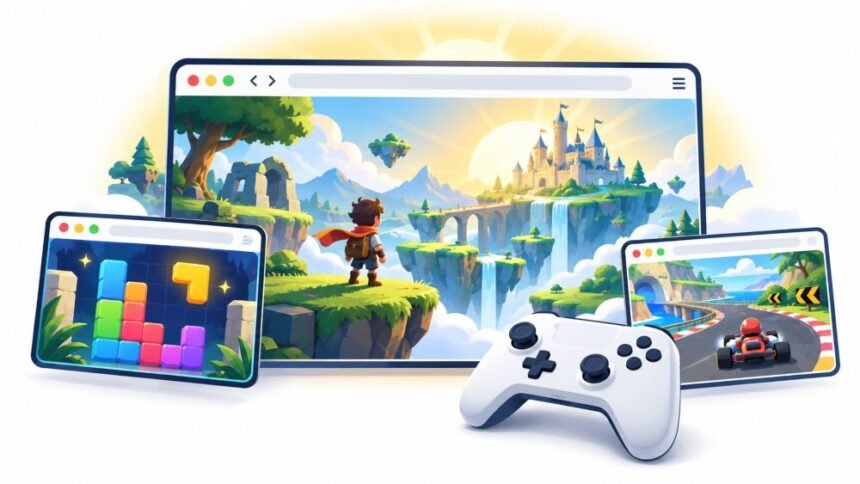
Say “browser game” to someone who has owned a console since the PlayStation 2 and watch the picture form behind their eyes. A 2009 portal wrapped in three ad banners. A Bejeweled clone with a stolen sprite sheet. Something you played in a computer lab because the school network blocked everything else.
That reaction is fair, and it was accurate for years. Flash died, the portals that survived leaned hard on ads, and the phrase “free browser game” became a warning label. Nobody who dismissed the category in 2015 was being a snob. They were reading the evidence in front of them.
The evidence changed. It changed quietly, without a launch event or a hardware cycle, and the people most invested in games as a hobby are frequently the last to notice, because nothing about the browser announces itself. There is no console under the TV to remind you it exists. So here is what actually happened, why it matters, and where the skeptics are still right.
Numbers Nobody Put On A Keynote Slide
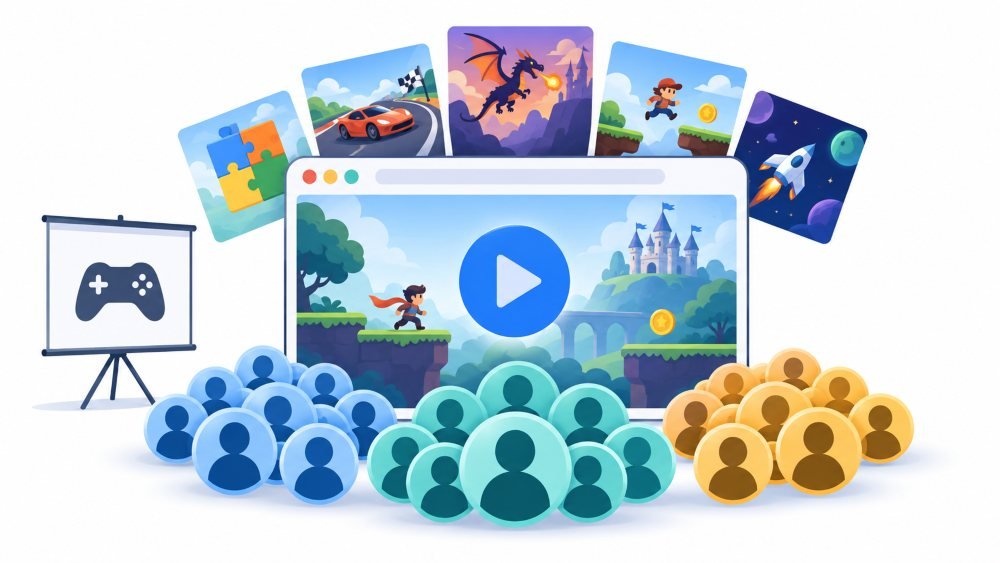
Start with the one that stops arguments. Poki, an Amsterdam web gaming company, reported reaching 625 million players in 2025 and roughly 100 million monthly active players in 2026, up from around 10 million in 2020. Its own announcement placed that figure alongside PlayStation Network’s 119 million monthly actives. The company employs about 65 people and has never taken outside investment.
Treat the comparison with the care it deserves, since monthly active users on a free web portal and on a paid console network are not the same unit of measurement, and Poki is quoting itself. Even discounted heavily, the trajectory is the story. Trade coverage of why browser games have become a serious commercial bet puts CrazyGames at around 61 million monthly visits, notes both platforms growing more than five-fold in five years, and cites research showing HTML5 game releases in the first half of 2025 nearly tripling year on year to roughly 15,000 titles.
Meanwhile, console spending grew in the low single digits, and the industry spent two years shedding staff. Game Developer’s look at the web game market, which most of the industry ignores, made the same point earlier and got a fraction of the attention that any mid-tier console announcement receives. That gap between what is happening and what gets covered is most of the answer to the question in this article’s title.
What Actually Changed Under The Hood
The dismissal rested on a technical assumption that used to be true: the browser was a toy runtime, so browser games had to be toys.
Three things dismantled that.
WebAssembly grew up. The Wasm 3.0 standard was finalized in September 2025, adding a 64-bit address space that breaks the old four-gigabyte ceiling, native garbage collection, native exception handling, and tail calls. In plain terms, the browser stopped being a place where you ran a stripped-down version of your game and became a place where a real compiler target lives.
Graphics caught up. WebGPU, which exposes modern GPU features including compute shaders, now ships by default in every major engine. Chrome has had it since 2023, and web.dev’s summary of WebGPU across major browsers marks the point where Safari closed the last gap. The old advice to stay on WebGL because of Safari is finished.
Engines stopped treating web export as an afterthought. Unity now supports mobile browsers as a first-class target, and its official browser compatibility documentation lists iOS Safari and Android Chrome rather than desktop alone. Godot ships WebAssembly SIMD by default and added a 64-bit web export that lifts its old memory ceiling, though its web renderer is still WebGL 2 only. PlayCanvas and Three.js, both web-native, have the most mature WebGPU paths of anyone.
None of this makes a browser tab equal to a PlayStation 5. It makes the gap between “browser game” and “small commercial game” close to zero, which is a different and more interesting claim.
Thing A Console Structurally Cannot Do
Here is the part the hardware crowd undervalues most, because owning a console trains you not to notice the cost.
Getting five friends into a game on console: everyone owns the same box, everyone owns the same title, everyone updates the title, everyone is in the same online service tier, everyone has the same regional store access. Twenty minutes on a good day: a download, a patch, and a licensing argument on a bad one.
Getting five friends into a browser game: paste a link.
That is not a small convenience. It is a different medium. It is why Skribbl, Gartic Phone, chess sites, and the entire .io genre took over group chats while the console ecosystem was still negotiating cross-play. Discord built on exactly this. Its Activities are documented as web apps running in an iframe inside the client on desktop, mobile, and web, and the Embedded App SDK that opened it to all developers shipped globally in March 2024. A Discord Activity is a browser game wearing a party hat, and hundreds of millions of people play them without ever using the words “browser game.
The console crowd measures platforms by ceiling. The browser wins on floor, and the floor is where most social play actually happens.
Browser Is Where Games Get Born Now
If you want one example that ends the shovelware argument, use this one. Vampire Survivors, the game that spawned an entire subgenre and sold millions across Steam, mobile, and console, was released on itch.io on March 31, 2021, as a free HTML5 browser game built in JavaScript. Steam Early Access came nine months later. The browser version still sits there, treated by its developer as a demo.
This is now a standard path rather than a fluke. Game jams run on web builds because a jam entry nobody can play in one click is a jam entry nobody plays. itch.io’s HTML5 category is the largest live experimental game library in existence, and it costs nothing to browse. Wordle was a static web page a man built for his partner before The New York Times bought it.
The browser has quietly become the prototyping layer, the demo layer, and the discovery layer for independent games. A console player who ignores it is not skipping a lesser tier of games. They are skipping the stage where a good chunk of the next few years of games is currently visible.
Preservation Is The Argument Nobody Expects
This one usually lands hardest with people who care about games as a medium.
Console libraries are evaporating. Storefronts close, licensed titles get delisted when a music or sports contract lapses, servers shut down, and digital-only purchases become unplayable on hardware you still own. That is the normal condition of console gaming, and it is getting worse, not better.
The browser went through its own extinction event when Adobe killed Flash in December 2020, and the response was the opposite. Ruffle, an open-source Flash Player emulator written in Rust and compiled to WebAssembly, now runs classic SWF content safely inside the modern browser sandbox with no plugin. Newgrounds integrated it in 2021. The Internet Archive’s Flash software library uses it to serve thousands of preserved games directly in a tab, and the Flashpoint Archive project reports preserving well over a hundred thousand games and animations across more than a hundred defunct web technologies.
A 2006 Flash game is more reliably playable today than a 2012 licensed console title. That should be embarrassing for the hardware side of this argument, and it rarely comes up.
Where The Skeptics Are Still Right
A fair case has to include the parts that have not improved, and several have not.
Fidelity still has a ceiling. No browser tab is running a 100-gigabyte open-world game at 4K. Cloud streaming in a browser gets you close, but that is a data center doing the work, not the browser, and it comes with latency and subscription costs.
The iPhone remains the weak link. Safari on iOS still lacks the Fullscreen API for ordinary page elements, and WebKit’s tracking prevention deletes script-based storage after roughly seven days of browser use without interaction with a site, which means browser game saves on iPhone can vanish through no fault of the developer. Adding a game to your Home Screen mitigates this. It does not eliminate it.
Discovery is bad. There is no curated storefront with a review system. There is SEO, portal algorithms, and word of mouth, which means the top result for any genre is often a clone with better keyword targeting than gameplay.
Quality variance is brutal. Fifteen thousand HTML5 releases in six months means fifteen thousand releases in six months, and the median is not good. The good stuff is real, and it is a minority.
And you do not own anything. There is no library, no refund window, no offline copy. A browser game you love can disappear when a domain lapses.
How To Actually Find The Good Ones
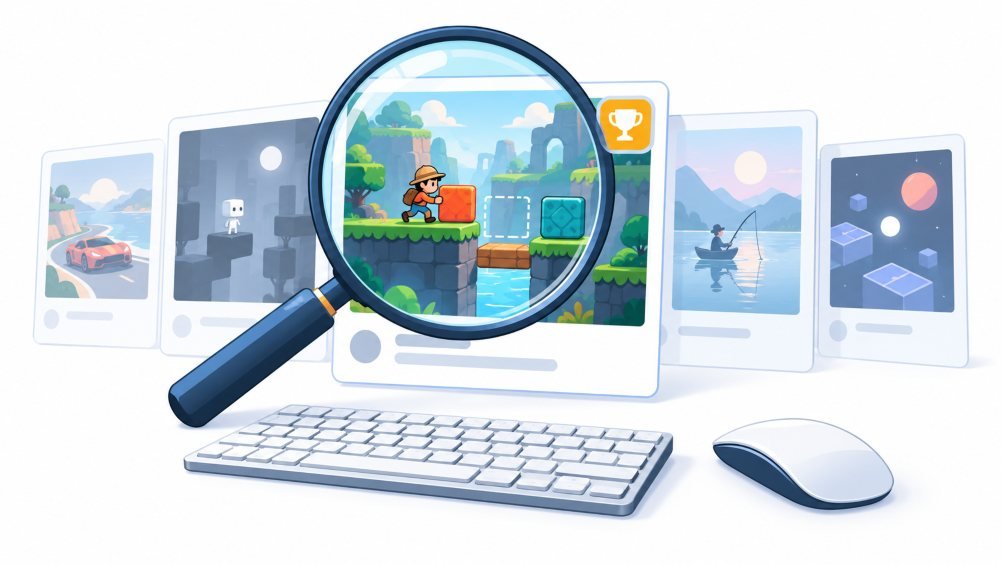
If the last section did not put you off, the practical route in is short.
Start at itch.io and filter by HTML5, then sort by recent game jam results rather than popularity. Jam winners are where the inventive work concentrates, and they play in one click.
Use Poki and CrazyGames for polished casual titles, understanding that both are ad-funded businesses and the ad load is the price. Newgrounds and the Internet Archive’s Flash collection cover the back catalog.
For anything with real depth, play on a desktop. Keyboard and mouse, no thermal throttling, no disappearing address bar, and storage that does not get cleared on a timer. If you are using a controller and inputs feel wrong, check the pad’s raw button and axis readings in a browser-based gamepad tester before blaming the game, since browsers deliberately hide a connected controller until you press a button on it.
And treat Discord Activities as the on-ramp for group play. The social friction is near zero, and that is the entire point.
Limits And Safety Worth Taking Seriously
Browser games skip app store review, which removes safety layers people assume are still present.
Advertising is the main risk. Free portals are ad-funded, and malicious advertising is the realistic threat, not the games themselves. Full-page redirects, fake update prompts, and anything insisting you install a file to continue should be closed rather than explored. A browser game never requires a download.
Permission prompts deserve the same skepticism. A puzzle game does not need your microphone, camera, location, or notifications. Deny by default.
The “unblocked games” ecosystem around schools and workplaces is worth a specific warning. Those sites frequently operate as proxies, are unvetted by anyone, and are among the most reliably malware-adjacent corners of the web. Using a school or employer network in ways that violate its policy is also a real consequence, separate from the security question.
For parents, the gap is structural. Console and app store parental controls do not cover browser games, because there is no store in the loop. Purchase restrictions, age ratings, and spending limits all live at the store level. Device-level content and screen time restrictions are the only tool that actually applies, and that takes a deliberate settings check rather than an assumption.
Money deserves care too. In-browser purchases sit outside App Store and Google Play refund systems. Where real-money gaming is involved, a site loading in your browser says nothing about whether it is licensed or lawful where you live, and age verification, regional restrictions, and self-exclusion tools vary enormously between operators.
Finally, the design itself. Many free web games are tuned around rewarded video ads and session-extension loops, the same psychology that drives free-to-play mobile. Knowing that the loop is engineered is most of the defense against it.
Short Version
Browser games are not a nostalgic category or a lesser tier. They are a hundred million people a month, an engine and standards stack that finally supports real work, the place a growing share of independent games get built and tested first, and the only part of gaming with a functioning preservation story.
None of that requires anyone to give up a console. It just means the tab sitting open next to this article is a more interesting platform than the last fifteen years of reputation would suggest, and the barrier to checking is one click.
Disclaimer: This article is for general information only. Platform figures are drawn from company statements and trade reporting, and monthly active user counts are self-reported by the platforms concerned and are not directly comparable across services. Browser capabilities, platform terms, and regional regulations change frequently. Verify current details against official sources for your own device and jurisdiction, particularly for anything involving real-money gaming. Nothing here constitutes legal or financial advice.